
 By
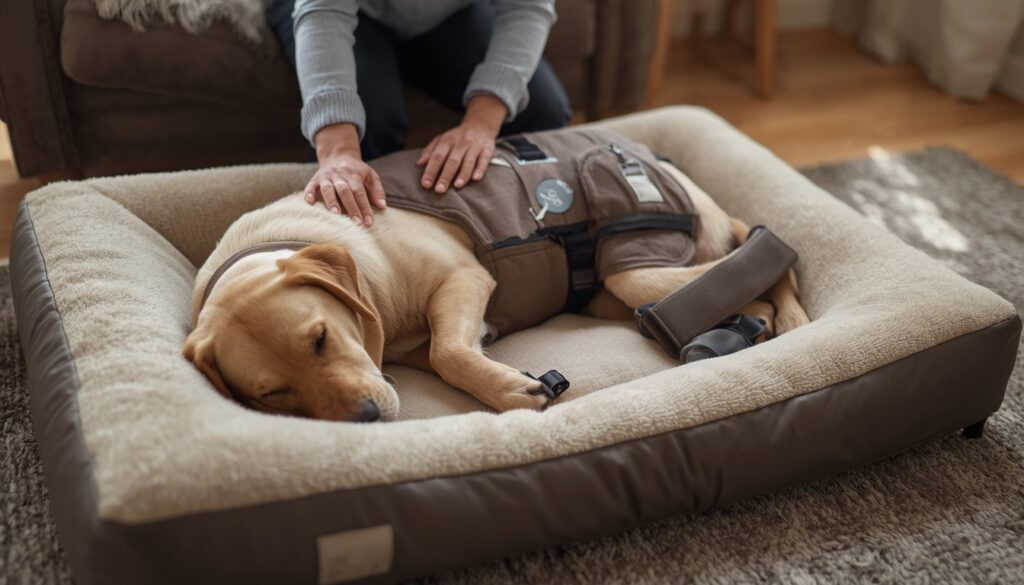
Aids help you follow the plan, they are not the plan
When a dog has surgery for a torn cranial cruciate ligament (the dog’s ACL), the operation is only half the job. The other half is the weeks of careful rest afterwards, and that is where most home problems happen: a slip on a hardwood floor, a leap off the sofa, a dash after a squirrel. The right equipment makes those risks smaller. It does not change what your surgeon tells you to do. If you are still weighing up the operation, our guide to what dog ACL surgery costs explains what an estimate should include.
Sample home-care sheets from veterinary clinics are consistent on the basics. Activity is restricted for about 8 to 12 weeks, your dog is confined to a crate or small room when you cannot watch, outdoor time is short leash walks, and the floors are kept non-slip. The products below are tools for those jobs.
How we chose
We have not tested these products hands-on. We shortlisted items that match what veterinary home-care instructions ask owners to do (support on stairs and slick ground, non-slip surfaces, confinement and no jumping), that are sold in the US, and that the maker describes clearly, including sizing. Your surgeon or rehab team knows your dog’s size, the type of surgery and the healing plan, so ask them before you buy a harness, and ask how to fit it.
Who needs what
- Large or heavy dogs usually benefit most from a support harness, because they are harder to steady by hand on stairs and wet ground.
- Dogs in homes with hardwood, tile or laminate need traction first: runners, mats, or toe grips.
- Dogs that bounce need a pen or small room. Dogs often seem recovered long before the bone has healed, so the limits stay in place until your surgeon says otherwise.
- Dogs that ride in the car to rechecks may need a ramp so they do not jump in or out.
What to look for
- Support in the right place. For a back leg, you want a sling or harness that supports the rear or the belly, not only a chest strap.
- Measure, do not guess. Makers size by weight or by chest, belly or girth measurements. A loose harness slides and a tight one rubs near the incision.
- A handle you can hold in one hand, so the other hand is free for the leash.
- Padding and washability. You will use it daily for weeks, and it will get muddy.
- Traction without sliding. Rubber-backed mats should stay put; runners that slide are a hazard of their own.
- Stable, closed containment. A pen should be tall enough that your dog cannot jump or climb out.
Our picks in more detail
Help ‘Em Up Harness: best full-body lift harness
This is a two-piece harness with a patented hip lift, ten adjustment points and optional handles. The maker describes it as a harness for dogs that could use help standing, walking, climbing stairs or getting into a vehicle, and it comes in five weight-based sizes from extra small to extra large. The maker’s page lists mobility problems such as arthritis rather than surgery recovery, so ask your surgeon whether this style suits your dog and how to fit it.
Worth knowing: there are different hip-lift styles, and the right one depends on your dog. Follow the maker’s measuring guide and get the fit checked.
GingerLead Support and Rehabilitation Harness: best simple rear sling
GingerLead is a padded sling that sits under the belly and clips to the collar, with a handle. Its maker describes it for dogs with weak or injured hind legs, including dogs recovering from surgery, and for short walks and toilet trips, not for wearing all day. It comes in male and female styles and several sizes; sizes differ mainly in pad width, so measure first.
Worth knowing: stock varies, and one retailer listed it as out of stock when we looked, so check the maker’s or another seller’s page.
Dr. Buzby’s ToeGrips: best for slippery floors
ToeGrips are rubber tips that fit on the toenails. Unlike boots or socks they leave the paw uncovered, and they let the nails grip hard floors. The maker lists dogs recovering from surgery, hind-end weakness and cruciate problems among the dogs they are meant for. They need correct sizing and fitting and typically need replacing after one to three months.
Worth knowing: ask your vet or rehab team before using them on a dog with a fresh surgery, and note that they work best on a dog that already walks reasonably well on rugs and grass.
MidWest Exercise Pen with Door: best for confinement outside the crate
A steel pen with a door, set up without tools, in several heights. It is meant for indoor use and can create a small area beside a crate, so your dog is safe when you step away. Choose a height your dog cannot clear, and put non-slip mats on the floor inside.
Worth knowing: the pen is only as good as the floor under it. Place it on carpet or a non-slip mat, not bare hardwood.
PetSafe Happy Ride Telescoping Dog Ramp: best for the car or a step
This aluminum and plastic ramp telescopes from roughly 47 to 87 inches, has a high-traction surface and side rails, and is rated for dogs up to 300 pounds according to the retailer listing. It is designed for getting into a car or truck without jumping. It is long and weighs about 18 pounds, so check that you can handle it.
Worth knowing: a ramp is steep for an unsteady dog. Use your support harness on it, go slowly, and only use it if your surgeon agrees.
Non-slip runners and rubber-backed mats: the cheapest fix
A line of long runners from the pen to the back door to the water bowl, with rubber backing so they do not slide, is often the most useful thing in the house. Tape down any corner that curls.
Which aid for which problem?
| The problem | What to look for |
|---|---|
| Slips on hardwood or tile | Non-slip runners, rubber-backed mats, or toe grips |
| Steps to the yard | A support sling or harness; stairs only for toilet trips |
| Wants to jump on the sofa or bed | A pen or closed door; no ramp until the surgeon agrees |
| Car trips to rechecks | A ramp or a gentle lift technique agreed with the clinic |
| Tries to lick or chew the incision | The cone or an alternative your surgeon approves; see our cone alternatives guide |
Using these safely
- Get the fit checked. Ask the surgery or rehab team to show you how it should sit before the first walk.
- Keep the leash short. Slow, controlled steps on flat ground with good footing.
- Do not lift the dog’s weight with the sling. It steadies and supports; it is not a stretcher.
- Take it off after the walk. Harnesses can rub, so check the skin and keep the incision clean and dry.
- Supervise everything. Falls can damage the implants, so do not leave the dog loose in an unsupervised room.
- Follow the exercise plan. Sample instructions build up leash walks gradually, a few minutes at a time, and rehab exercises usually begin a week or two after surgery under your vet’s direction.
What the first weeks usually look like
Every surgeon’s plan is different, so treat this as a rough picture and follow your own discharge sheet. One sample set of instructions from a canine rehabilitation organisation suggests walks of up to about five minutes, three or four times a day, in the first two weeks, then adding around five minutes a week if your dog uses the leg with every step. By about eight weeks, many dogs build up to longer, steady walks, as long as they are not lagging or limping more at the end. A veterinary rehabilitation article describes home exercises starting one to two weeks after surgery, such as gentle knee bending and weight-shifting, and adds that anything outside the prescribed plan should be restricted.
Two points follow from this. First, a harness or ramp is most useful early, when your dog is weakest and the risk of a slip is highest. Second, the rest area matters as much as the equipment. A pen or small room with a non-slip floor, a supportive bed and water within reach means you can leave the room without worrying. Reducing food slightly is often part of the plan to avoid weight gain while your dog moves less, so ask your surgeon before changing portions.
Setting up the house before you bring your dog home
- Lay runners or mats on every hard-floor route your dog will use, and test that they do not slide.
- Set up the pen or crate area before surgery day, so your dog comes home to a ready space.
- Close doors or add gates to keep your dog away from stairs and furniture.
- Keep the leash, harness, cone and any medicines together by the door.
- Plan the car trip home: a second person helps, and the clinic can show you how to lift or guide your dog in safely.
When to call the surgeon instead
- Your dog suddenly becomes more lame, or stops using the operated leg after using it
- The incision opens, bleeds, swells, turns red or drains fluid
- Your dog cries out when the area is touched gently
- Vomiting, fever, depression or refusal to eat
No product fixes these. They need a call to the surgical team the same day. If it is after hours, a nearby 24-hour emergency vet can advise.
Common mistakes
- Relaxing the rules when your dog seems fine. Dogs often look recovered long before the bone has healed.
- Buying the wrong size. Measure with the maker’s guide; if your dog is between sizes, read the sizing notes.
- Leaving slippery floors uncovered because the harness is “enough”.
- Letting your dog jump on and off furniture or into the car.
- Forgetting the other knee. Cruciate problems often show up in the second leg later, so the traction and non-slip habits are worth keeping up long term.