
 Written by
First, do these five things
- Get your dog out of the heat. Move to shade, or better, an air-conditioned room or car.
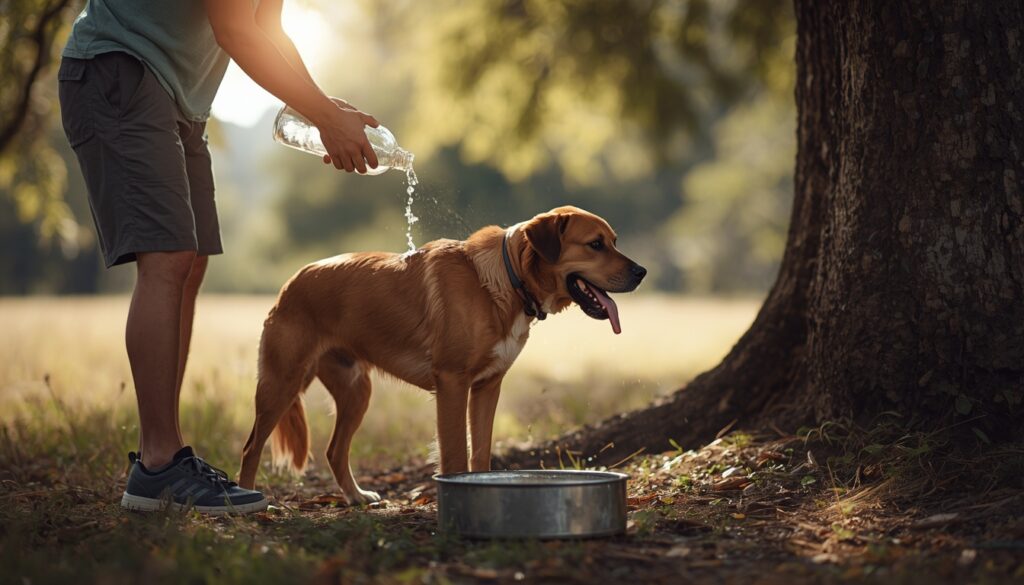
- Start cooling straight away. Wet your dog’s body with cool water from a hose, tap, bottle or bucket, paying attention to the neck, chest, belly and legs. Then get air moving over the wet coat with a fan, a breeze or the car’s air conditioning.
- Call a vet or a 24-hour emergency hospital while you cool, or have someone else call. Tell them what happened and that you are on your way.
- Go. Drive with the air conditioning on high and the vents pointed at your dog. Do not spend a long time cooling at home when a clinic is close.
- Offer small sips of cool water if your dog is alert and wants to drink. Do not force water into its mouth.
Heat stroke is one of the few emergencies where the first minutes at home change the outcome. Cool and call at the same time. In Houston, the hospitals in our listings that are open all night are on the 24-hour emergency vets page.
Emergency or wait? A quick guide
Red: cool your dog and go to an emergency vet now
- Collapse, or a dog that cannot stand or walk straight
- A seizure, confusion, or a dog that does not respond to you
- Heavy panting or noisy, labored breathing that does not ease within a few minutes of rest in a cool place
- Gums that are bright red, pale, purple or blue
- Vomiting or diarrhea in a hot dog, especially with blood
- A rectal temperature of 104°F or higher after heat or exercise, if you are able to take it safely
- Any dog found in a hot car or a closed, hot space, even if it perks up afterwards
Amber: cool your dog and call a vet today
- Your dog panted hard, drooled and slowed down in the heat, then settled within a few minutes once cool
- Your dog is flat-faced, elderly, overweight or has heart or airway disease, and struggled in the heat at all
- Your dog seems tired, off its food or not quite itself in the hours after getting too hot
- You are not sure how long your dog was in the heat
Describe exactly what you saw. The vet may ask you to come in for an exam and blood tests, because damage from overheating can show up later.
Green: rest and watch at home
- Your dog was warm and panting after normal activity, cooled down quickly indoors, and is now bright, drinking and behaving normally
Keep the rest of the day quiet and cool. Go back to the phone if panting returns, or if your dog vomits, has diarrhea, seems weak or will not eat.
What heat stroke is
A dog’s normal body temperature is about 100.5 to 102.5°F. Heat stroke happens when the body takes on heat faster than it can lose it. Cornell’s canine health center describes it as a temperature of 105°F or higher that the dog can no longer bring down.
Dogs are poorly built for heat. They have sweat glands only in their paw pads, so they cool mainly by panting. Panting works by evaporating moisture from the mouth and airways. In humid air, or in a closed space with no airflow, that evaporation slows and panting stops working. This is why Texas A&M veterinarians single out hot, humid weather and poorly ventilated places such as parked vehicles.
Vets at Texas A&M describe two stages:
| Stage | Body temperature | What you may see |
|---|---|---|
| Heat exhaustion | Roughly 103 to 106°F | Heavy panting, stopping play, lying in shade or on cool floors |
| Heat stroke | Above about 106°F | Collapse or weakness, drooling, labored breathing, disorientation, seizures, sudden vomiting or diarrhea |
Source: Texas A&M School of Veterinary Medicine & Biomedical Sciences, Pet Talk, 2023. Sources draw the line in slightly different places: AAHA uses about 104°F and Cornell 105°F. The exact number matters less than the direction. A hot dog that is getting worse needs cooling and a vet.
Why it is so dangerous
High body temperature damages proteins in almost every cell. A Texas A&M emergency vet lists the results above 105°F as blood clotting problems, shock, severe dehydration, kidney and liver damage and changes in the brain, with multi-organ failure and death a risk above 107°F. Cornell adds that the outlook depends on how high the temperature goes and how long it stays there. That is the reason to start cooling before you reach the clinic.
Dog heat stroke symptoms
- Early: fast, heavy panting that does not settle; thick, ropey drool; seeking shade; slowing down or refusing to walk; skin that feels hot
- Getting worse: bright red gums; a racing heartbeat; vomiting or diarrhea; weakness; wobbling or stumbling; looking dazed
- Severe: pale, purple or blue gums; bloody diarrhea; bruising on the gums; collapse; seizures; loss of consciousness
Not every dog goes through these in order. A dog shut in a car can go from panting to collapse fast.
Which dogs are most at risk
- Flat-faced breeds such as bulldogs, pugs, boxers and Boston terriers. Their narrow airways make panting less effective, a problem vets call brachycephalic obstructive airway syndrome. VCA notes these dogs can get into trouble when heat and humidity are only moderate.
- Overweight dogs. Fat holds heat in and makes breathing harder.
- Puppies and senior dogs.
- Dogs with thick or dark coats.
- Dogs with heart disease or airway disease, including laryngeal paralysis.
- Dogs wearing a muzzle, which limits panting.
- Dogs that are not used to exercise, or to the heat, at the start of the warm season.
Texas heat: the three usual causes
Parked cars
This is the classic cause, and it does not need a very hot day. The AVMA publishes these estimates of the air temperature inside a closed vehicle.
| Time parked | 80°F outside | 90°F outside | 95°F outside |
|---|---|---|---|
| 10 minutes | 99°F | 109°F | 114°F |
| 20 minutes | 109°F | 119°F | 124°F |
| 30 minutes | 114°F | 124°F | 129°F |
| 60 minutes | 123°F | 133°F | 138°F |
Source: American Veterinary Medical Association, Pets in vehicles (figures from Jan Null, San Francisco State University). The AVMA adds that cracking the windows has very little effect. The Merck Veterinary Manual says the same of parking in the shade.
If you see a dog in distress in a parked car, try to find the owner quickly and call 911.
Exercise in humid heat
Fetch, running and long walks produce a lot of body heat. On a humid Gulf Coast afternoon a dog cannot pant it away. Walk early in the morning or after dark in summer, keep it short, and stop at the first sign of heavy panting or lagging behind. Hot pavement is a second hazard: Merck warns that hot asphalt and sand can burn paw pads badly.
Yards, patios and garages without shade or water
Dogs left outside need shade that lasts all day as the sun moves, air that moves, and water that cannot be tipped over. A closed garage, shed or dog house can trap heat much like a car.
Cooling your dog: what the sources agree on, and where they differ
They agree on this:
- Start cooling at once and get veterinary help at the same time.
- Water on the dog plus moving air works. Evaporation carries the heat away.
- Do not wrap or cover your dog in wet towels. AAHA and VCA both warn that this traps heat and slows evaporation.
- Do not use ice or ice baths, and do not use rubbing alcohol.
- Do not over-cool. If you can take a rectal temperature safely, AAHA and VCA say to stop active cooling at about 103°F, because the temperature can keep dropping too far.
They differ on how cold the water should be. AAHA, Merck, VCA and Texas A&M advise cool or tepid water and warn against submerging a dog in cold water. Researchers at the UK’s Royal Veterinary College argue that this caution is not well supported by evidence, and recommend cold-water immersion for young, healthy dogs and water-plus-airflow for older or unwell dogs, under the rule “cool first, transport second”.
For an owner the practical answer is the same either way. Use whatever cool water you have, right now, keep air moving, and let the vet on the phone guide the details. Never put a collapsed or unconscious dog into a tub or pool; Texas A&M notes the particular danger of submerging a pet that has lost consciousness.
What happens at the vet
- Triage. Staff take a rectal temperature, check breathing, gums, heart rate and alertness, and ask what happened and what cooling you have done.
- Controlled cooling. The team continues cooling while tracking the temperature so it does not overshoot.
- Fluids and oxygen. Intravenous fluids treat shock and dehydration and protect the kidneys. Oxygen helps dogs that are struggling to breathe.
- Blood tests. Cornell lists bloodwork to look for organ damage, plus checks of blood sugar, electrolytes and clotting times, blood pressure and an ECG as needed.
- Treating complications. Depending on results, this can include glucose and electrolytes, anti-nausea and gut-protecting medicines, antibiotics, anti-seizure medicine, pain relief, and plasma for clotting problems.
- Monitoring. Organ damage can appear over the following hours and days, so dogs with true heat stroke are usually kept in hospital and blood tests are repeated.
This is intensive care, and the bill reflects that. Ask for an estimate at the start; clinics expect the question. Our guide to what a vet visit costs explains how exam and emergency fees are usually charged.
Outlook
It depends on how hot the dog became, for how long, and its health beforehand. VCA says most healthy pets recover quickly if the temperature did not get extremely high and treatment was immediate. Cornell is blunt about the severe end: many dogs with heat stroke do not survive. The Royal Veterinary College, citing earlier UK research, puts survival at 97% for dogs treated for mild heat-related illness and 43% for dogs with severe heat stroke.
Dogs that pull through can be left with lasting organ damage, and are more likely to overheat again.
What not to do
- Do not wait to see if it passes. Cool and call.
- Do not drape wet towels over your dog or shut it in a crate while it is wet and hot.
- Do not use ice baths or rubbing alcohol.
- Do not force water into the mouth of a weak or dazed dog.
- Do not give human medicines for fever or pain. They do not treat heat stroke and several are poisonous to dogs.
- Do not skip the vet because your dog looks better.
Preventing heat stroke
- Never leave a dog in a parked car, even for a quick stop, even with the windows down.
- In summer, walk at dawn or after dark. Skip hard exercise on hot, humid days.
- Check the pavement before a walk, and keep to grass and shade where you can.
- Give outdoor dogs all-day shade, airflow and plenty of water, and bring them inside during extreme heat.
- Carry water on every outing.
- Know your dog’s risk. Flat-faced, overweight, elderly and thick-coated dogs need shorter outings and closer watching. A cooling mat indoors can help them rest comfortably.
- Build fitness slowly in spring, before the heat arrives.
- Save your vet’s number and your nearest 24-hour hospital in your phone. If you are in Houston, you can find clinics near you in our Houston vet directory.
When in doubt, cool your dog and call. A vet would rather hear from you early than see your dog late.