
 Written by
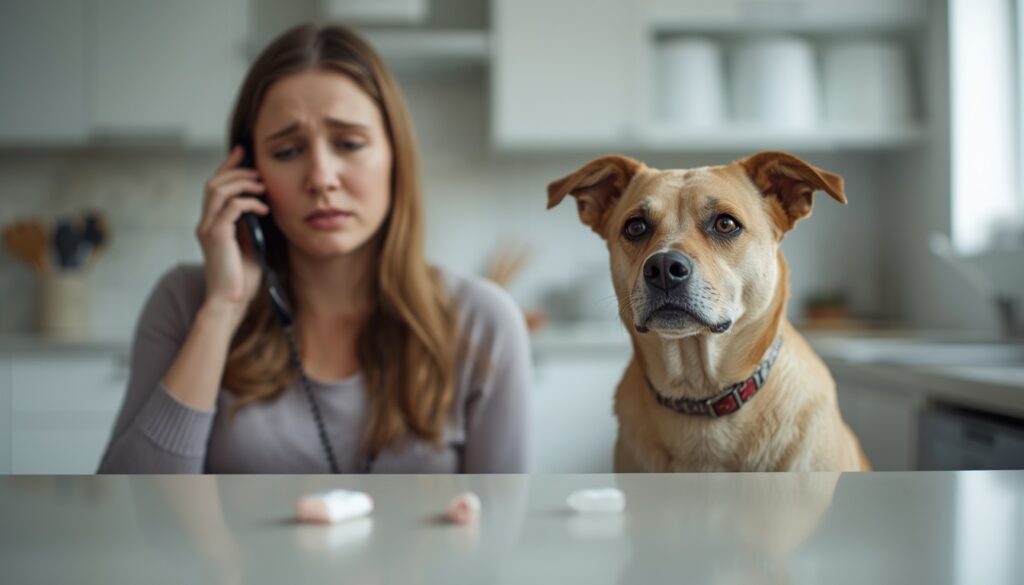
First, do these four things
- Take the product away and keep the packaging. The ingredient list and pack size are what a vet needs most.
- Work out roughly how much is missing and when your dog ate it. A best guess is fine.
- Know your dog’s weight, or your best estimate.
- Call for advice now. Call your vet, a 24-hour emergency hospital, or a pet poison line: ASPCA Animal Poison Control at (888) 426-4435 or Pet Poison Helpline at (855) 764-7661. Both lines are open day and night, and both may charge a fee.
Do not wait to see whether your dog gets sick. Xylitol can act within minutes, and a dog that looks normal now may not be in half an hour. The FDA’s advice is to get to a vet or emergency animal hospital right away, even before signs appear. Do not try to make your dog vomit unless a vet or poison line tells you to.
Emergency or wait? A quick guide
With xylitol there is very little “wait”. Use this list to decide how fast to move, not whether to call.
Red: go to an emergency vet now
- Your dog ate a product that lists xylitol, birch sugar or wood sugar, and you cannot reach a vet or poison line within a few minutes
- Weakness, wobbling, stumbling, or a dog that cannot stand
- Unusual sleepiness, confusion, or a dog that is hard to wake
- Tremors, a seizure, or collapse
- Vomiting after eating a sugar-free product
- In the days after: yellow gums, skin or whites of the eyes, bruising or bleeding, black stools, or refusing food
Phone the hospital from the car if you can, and bring the packaging. In Houston, the hospitals in our listings that are open all night are on the 24-hour emergency vets page.
Amber: call a vet or poison line this minute
- Your dog ate a sugar-free or “no sugar added” product and you have not yet checked the label
- The label lists xylitol and your dog seems completely normal
- You found chewed gum wrappers, a torn purse or an empty pack, and do not know how much was eaten
- Your dog licked or ate toothpaste, mouthwash, chewable vitamins or a liquid medicine made for people
The person you speak to will use your dog’s weight and the product to judge the risk. Expect to be told to come in. Stay with your dog while you call, and be ready to leave.
Green: watch at home, but only after you have been told it is safe
- You have read the full ingredient list and it does not contain xylitol, birch sugar or wood sugar
- A vet or poison line has checked the product and the amount and told you your dog can be watched at home
Even then, watch closely for the next day. Call back or go in if your dog vomits, seems weak or wobbly, trembles, or is not itself.
Why xylitol is dangerous for dogs
Xylitol is a sugar alcohol used to sweeten food without sugar. It is safe for people. Dogs handle it very differently.
Low blood sugar. In people, xylitol does not make the pancreas release insulin. In dogs it does, quickly and strongly. Cornell’s canine health center describes the release as three to seven times the insulin a dog would need for the same amount of ordinary sugar. Insulin pushes sugar out of the blood, so blood sugar falls sharply. Vets call this hypoglycemia. The brain runs on blood sugar, which is why the signs are weakness, wobbling, seizures and coma.
Liver damage. Larger amounts can also injure the liver, and in some dogs cause liver failure. The Merck Veterinary Manual says the reason is not fully understood. Liver injury can happen even in a dog that never showed low blood sugar, so a dog that “got through the first night” still needs the follow-up blood tests its vet recommends.
How much is too much?
Merck gives two thresholds. These are the only dose figures in this guide, and they are a guide for vets, not a safety line for owners.
| Amount of xylitol eaten | What it can cause |
|---|---|
| Above about 100 mg per kg of body weight (about 45 mg per lb) | Low blood sugar |
| Above about 500 mg per kg of body weight (about 227 mg per lb) | Severe liver damage or liver failure in some dogs |
Source: Merck Veterinary Manual, Xylitol Toxicosis in Dogs.
Going by the lower figure, a 10-pound dog reaches the low blood sugar range at roughly 450 mg of xylitol, which is less than half a gram. The difficulty is that labels rarely say how much xylitol is in a product. The ASPCA notes that the amount in a piece of gum varies between brands, and even between flavors of the same brand. That is why the safe move is to call with the product name and let a vet or poison line look it up.
Signs of xylitol poisoning and when they start
| When | What you may see | Source |
|---|---|---|
| 10 to 60 minutes | Vomiting, then tiredness, weakness, staggering, collapse, seizures | FDA |
| Up to 12 to 18 hours | The same signs, delayed, when the product slows absorption (some gums) | Merck |
| 24 to 48 hours | Signs of liver injury: tiredness, vomiting, yellow gums or eyes, bruising or bleeding | Merck |
Two points follow from this. A dog that is fine an hour after eating gum is not in the clear. And a dog can feel better after treatment for low blood sugar while its liver values are still rising, which is why vets repeat blood tests over several days.
Where xylitol hides
Sugar-free gum is the most common source of xylitol poisoning in dogs, according to the ASPCA. It is far from the only one. Xylitol may also appear on a label as birch sugar or wood sugar.
| Type of product | Examples named by the FDA, ASPCA, Merck, Cornell or Pet Poison Helpline |
|---|---|
| Candy and gum | Sugarless gum, mints, sugar-free candy and chocolate bars |
| Foods | Some peanut and nut butters, baked goods (including homemade), sugar-free pudding and ice cream, energy bars, protein powder |
| Dental products | Toothpaste, mouthwash, dental floss |
| Medicines and supplements | Chewable and gummy vitamins, cough syrup, sleep aids, nasal sprays, some liquid prescription medicines |
| Personal care | Skin care products, lotions, sunscreen, deodorant, shaving cream, hair products |
Three of these catch owners out again and again:
- Peanut butter. Many people use it to hide pills or fill a chew toy. Read the label on every new jar.
- Human toothpaste. Brush your dog’s teeth only with toothpaste made for pets. Our guide to dog dental care products covers pet-safe options.
- Liquid medicines. Merck notes that some sugar-free syrups used as a base for medicines contain xylitol. If your dog is prescribed a liquid medicine that is filled at a human pharmacy, ask the pharmacist to check that it is xylitol-free.
Sugar-free chocolate carries two risks at once. If that is what your dog ate, tell the vet about both, and see my dog ate chocolate.
What happens at the vet
There is no test that detects xylitol. Cornell notes that vets diagnose it from what was eaten, the signs, and blood tests for sugar and liver values. This is why the packaging matters.
- Triage and questions. Staff check alertness, heart rate and temperature, and ask what was eaten, how much and when.
- Blood sugar check. A quick test from a drop of blood, often before anything else. Liver values are measured too when the amount eaten was large.
- Emptying the stomach, sometimes. If your dog ate the product recently and is still acting normally, the vet may give a medicine to bring on vomiting. Xylitol is absorbed fast, so the window is short, and vets do not do this in a dog that already shows signs.
- No charcoal. Activated charcoal is used for some poisons, but Merck does not recommend it here because it does not bind xylitol well.
- Sugar through a drip. Dogs with low blood sugar are given dextrose, a form of sugar, into a vein, and kept on it until they can hold a normal level on their own. Merck advises giving it to dogs that ate a large amount even if their blood sugar is still normal.
- Close monitoring. Merck recommends checking blood sugar every one to two hours for at least 12 hours, and liver values daily for at least 72 hours. Cornell says to expect a hospital stay of at least 12 to 24 hours.
- Liver support. Depending on the amount eaten and the blood results, vets may add medicines intended to protect the liver, anti-nausea medicine and fluids.
Ask for a cost estimate before treatment starts; clinics expect the question. Our guide to what a vet visit costs explains how exam and emergency fees are usually charged.
Outlook
For most dogs that are treated early, the outlook is good. Merck describes the prognosis as good for low blood sugar that is treated promptly, and says mild rises in liver values usually settle within a few days. In a study of 192 dogs taken to three university veterinary hospitals after eating xylitol, about one in six developed low blood sugar in hospital, and every dog survived to go home.
Liver failure is a different matter. Merck calls the outlook guarded for dogs with severe liver injury, and cites one study in which 62.5% of dogs with signs of liver injury died or were put to sleep despite intensive treatment. Speed is the part you control: the sooner a vet is involved, the more likely the problem stays at the “low blood sugar” stage.
What not to do
- Do not wait for signs. Blood sugar can be falling before you see anything.
- Do not make your dog vomit on your own. A dog whose blood sugar is dropping can become weak or have a seizure, which makes vomiting dangerous. Do it only if a vet or poison line tells you to and explains how.
- Do not treat it yourself with sugar, honey or syrup and stay home. If a vet or poison line tells you to give something on the way to the clinic, follow their instructions. It is not a substitute for the visit.
- Do not give human medicines or other home remedies.
- Do not skip the recheck. Liver injury can show up a day or two later, after your dog seems well.
Keeping xylitol away from your dog
- Read the ingredient list on anything labeled sugar-free, low sugar, no sugar added or keto, and look for xylitol, birch sugar and wood sugar.
- Keep purses, backpacks, gym bags and coat pockets off the floor and out of reach. That is where gum and mints usually are.
- Store gum, candy, vitamins and medicines in closed cupboards, and do not leave them in the car with your dog.
- Use a bin your dog cannot open. Chewed gum and empty packs still contain xylitol. See our guide to dog-proof trash cans.
- Tell guests, children and dog sitters that sugar-free treats are not for the dog.
- Save your vet’s number, your nearest 24-hour hospital and a poison line in your phone today. If you are in Houston, you can find clinics near you in our Houston vet directory.
When in doubt, call. With xylitol, a phone call in the first few minutes is the most useful thing you can do for your dog.