
 Written by
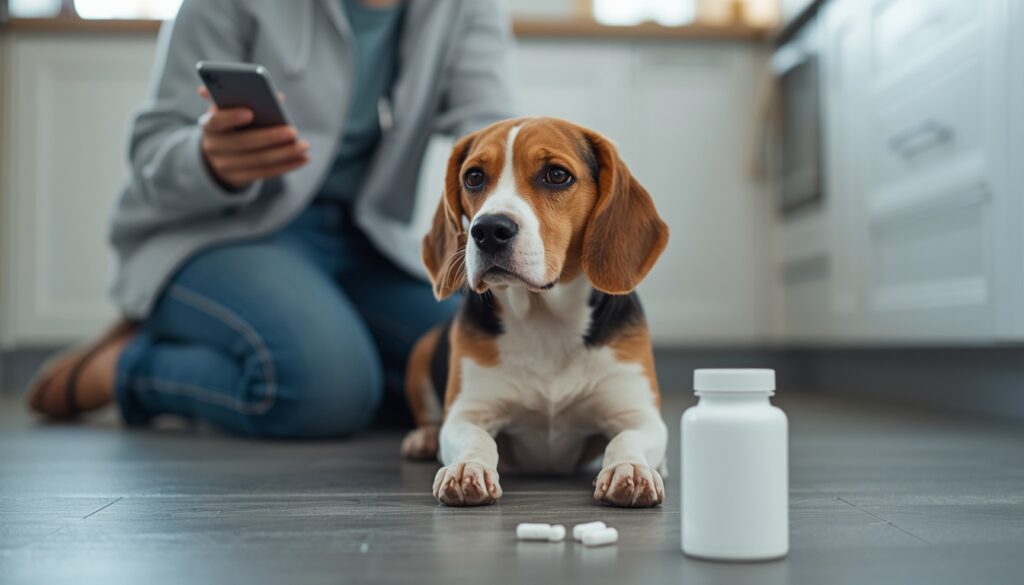
First, do these four things
- Take the rest away and pick up any loose tablets. Keep the bottle or blister pack.
- Call now. Phone your vet or an emergency hospital, or a pet poison line: ASPCA Animal Poison Control on (888) 426-4435 or Pet Poison Helpline on (855) 764-7661. Both are open around the clock and may charge a fee.
- Have the facts ready: the exact product name, the strength in milligrams per tablet, how many are missing, when it happened, and your dog’s weight. Say if the label reads “PM”, “cold and flu”, “extended release” or lists more than one active ingredient.
- Do not make your dog vomit, and do not give any other medicine, until the vet or poison line has told you what to do.
Do not wait for your dog to look sick. Treatment works best before the drug is absorbed. In Houston, the hospitals in our listings that stay open all night are on the 24-hour emergency vets page.
Emergency or wait? A quick guide
Red: call and go to a vet now
- Your dog swallowed ibuprofen, naproxen, aspirin or acetaminophen and you cannot be sure the amount was tiny for its size
- A small dog or a puppy swallowed any at all
- Your dog chewed open a bottle and you do not know how many tablets are gone
- Vomiting, especially with blood or dark specks like coffee grounds (see dog vomiting blood)
- Black, tarry or bloody stool
- Gums that are pale, bluish, brown, muddy or yellow
- A swollen face or swollen paws
- Fast or hard breathing, wobbling, tremors, seizures, extreme sleepiness or collapse
- Drinking and urinating far more than normal, or passing very little urine
- A cat swallowed any of these drugs
Amber: call a vet or poison line now and follow their advice
- A large dog swallowed a single regular-strength tablet and is acting normally
- You found a chewed tablet or an open bottle and are not sure whether your dog swallowed any
- Someone in the home gave your dog a human pain reliever in the last day or two, even if it seemed to help
Amber still means a phone call right away. Let the vet or poison line decide whether your dog comes in.
Green: watch at home
- A vet or poison line has checked the drug, the amount and your dog’s weight, and told you home monitoring is enough
There is no green category you can choose on your own once a tablet is missing. If you are in doubt, call.
Which pill was it? The drug decides the danger
Read the active ingredient on the label, not just the brand name. These drugs do not harm dogs in the same way.
| Active ingredient | Common US brands | Main harm in dogs |
|---|---|---|
| Ibuprofen (an NSAID) | Advil, Motrin, Midol | Stomach and intestinal ulcers and bleeding; kidney failure at higher amounts; tremors, seizures or coma at very high amounts |
| Naproxen (an NSAID) | Aleve, Naprosyn | The same pattern as ibuprofen. It stays in a dog’s body far longer, and Merck reports bleeding and vomiting after much smaller amounts |
| Aspirin (an NSAID) | Bayer, Bufferin, Ecotrin | Stomach ulcers and bleeding; at high amounts fever, fast breathing, seizures or coma |
| Acetaminophen (not an NSAID) | Tylenol, and many cold, flu and “PM” products | Liver damage; at higher amounts, red blood cells that cannot carry oxygen |
Sources: FDA brand list (2022); Merck Veterinary Manual (reviewed 2024).
Many products mix drugs. VCA Animal Hospitals notes that ibuprofen and acetaminophen are both sold combined with decongestants, antihistamines, opioids or caffeine, and those extras carry their own risks.
Ibuprofen, naproxen and aspirin: what they do to a dog
These drugs are NSAIDs, short for nonsteroidal anti-inflammatory drugs. They work by blocking substances called prostaglandins. Prostaglandins drive pain and swelling, but they also protect the stomach lining and keep blood flowing to the kidneys. The FDA explains that without them a dog can develop ulcers, even holes, in the stomach or intestines, and sudden kidney failure.
The FDA adds that an NSAID made for people may last longer in a dog, be absorbed faster and reach higher blood levels. The Merck Veterinary Manual describes ibuprofen as having a narrow margin of safety in dogs, and lists human NSAIDs among the most common poisonings reported to animal poison control centers.
How much is too much?
Vets work this out in milligrams of drug per kilogram of body weight. The figures below are for ibuprofen swallowed at one time. They show why the call matters; they are not a reason to wait.
| Ibuprofen swallowed at one time | What has been reported in dogs | Source |
|---|---|---|
| As low as 25 mg/kg | Vomiting | ASPCA Animal Poison Control Center review (2004) |
| 100 to 125 mg/kg | Vomiting, diarrhea, nausea, belly pain, not eating | Merck Veterinary Manual (reviewed 2024) |
| 175 to 300 mg/kg | Kidney failure may occur | Merck Veterinary Manual |
| Above 400 mg/kg | Seizures, wobbling, coma, along with stomach and kidney signs | Merck Veterinary Manual |
| Above 600 mg/kg | Potentially lethal | Merck Veterinary Manual |
To put the first row in household terms: one regular 200 mg tablet is about 25 mg/kg for a dog that weighs 8 kilograms, or roughly 18 pounds. A small dog reaches the higher rows with only a few tablets. Repeated small doses are dangerous too: the ASPCA review describes ulcers in dogs given low daily amounts that showed no outward signs at all.
These numbers do not carry over to naproxen. It lingers in a dog’s body for days, and Merck reports vomiting, belly pain and black stool after a single dose of 35 mg/kg.
Signs and timing
The ASPCA review says vomiting, belly pain, bloody vomit and diarrhea can appear within 24 hours, and that early signs of kidney injury have been found on urine tests in as little as 18 hours. Kidney trouble may show up as heavy drinking and urination, then very little urine and low energy.
Acetaminophen (Tylenol): a different poison
Acetaminophen is not an NSAID. The FDA describes two main effects in pets: liver damage that can lead to liver failure, and damage to red blood cells that stops them carrying oxygen. Dogs are more likely to get the liver damage.
The Merck Veterinary Manual reports that dogs usually show signs of sudden poisoning only above about 100 mg/kg, and the red blood cell problem above about 200 mg/kg. It also warns that poisoning can happen at lower amounts when the drug is given repeatedly. Pet Poison Helpline warns that the margin of safety in dogs is narrow.
Signs listed by Merck and VCA Animal Hospitals include:
- Vomiting, belly pain, not eating, low energy
- Swelling of the face or paws
- Fast heart rate, fast breathing or heavy panting
- Gums that turn pale, bluish, brown or muddy
- Yellow gums, skin or eye whites (jaundice), usually later
- Squinting, eye discharge or a sore eye from sudden “dry eye”, mainly in small breeds
VCA notes that large amounts can cause signs within hours, while liver damage after smaller amounts may take several days to appear.
What not to do at home
- Do not make your dog vomit unless a vet or poison line tells you to. It is unsafe for a dog that is drowsy, wobbly or already vomiting.
- Do not give a stomach remedy on your own. Pepto-Bismol contains a salicylate, a relative of aspirin, and the ASPCA review tells vets to avoid it in these cases.
- Do not give another pain reliever. The FDA warns that combining two NSAIDs, or an NSAID with a steroid such as prednisone, raises the risk of gut damage.
What happens at the vet
- Questions and an exam. The team works out the amount per kilogram from the label and your dog’s weight, and checks gum color, heart rate, breathing and the belly.
- Emptying the stomach. If the tablets went down recently and your dog is bright and alert, the vet may give a medicine to cause vomiting. The ASPCA review says this is most useful within about two hours of swallowing.
- Activated charcoal. This binds drug still in the gut. With ibuprofen and naproxen it may be repeated, because these drugs are recycled through the liver and gut.
- Blood and urine tests. A baseline shows how the kidneys, liver and red blood cells are doing. Merck advises rechecking kidney values at 24, 48 and 72 hours after an NSAID, and liver values at 24 and 48 hours after acetaminophen.
- Fluids into a vein. After a risky amount of an NSAID, fluids protect the kidneys. The ASPCA review describes at least 48 hours of fluids, with daily kidney tests, before the drip is slowed and stopped.
- Stomach protection. Acid reducers, a coating medicine and anti-nausea drugs are common. The ASPCA review advises continuing stomach protectants for 7 to 14 days or longer after ibuprofen, and VCA mentions a bland diet for several days.
- For acetaminophen, vets can give N-acetylcysteine, which Merck describes as a potential antidote, along with liver support. Dogs with badly affected red blood cells may need a blood transfusion.
How long your dog stays depends on the drug and the amount. Two days of fluids and repeat blood tests means a hospital stay of at least that long. Our emergency vet cost guide explains how after-hours bills are built.
Outlook
Merck says the outcome depends on how much was swallowed and how soon treatment starts. VCA describes the outlook after acetaminophen as excellent when dogs are treated early. After ibuprofen, it notes that kidney or liver damage, if it happens, can be permanent in some dogs.
If a cat got into the pills too
Cats are in more danger than dogs. The FDA states that acetaminophen is fatal to cats, and Merck reports that ibuprofen poisons cats at about half the dose that harms a dog. Brown, blue or pale gums in a cat, a swollen face or hard breathing after any human pain reliever means leave for a vet now.
Keeping it from happening again
- Store all medicine in a closed cabinet, not on a nightstand or in a bag on the floor. The ASPCA review notes that some ibuprofen tablets have a sweet coating that dogs eat readily.
- Use a bin your dog cannot open for used blister packs and tissues. Our guide to dog-proof trash cans lists some options.
- Never share your own pain medicine with a pet. If your dog is limping, stiff or sore, a vet can prescribe a pain reliever made for dogs. See the Houston vet directory.
The short version
If your dog swallowed a human pain reliever, keep the package, call a vet or a pet poison line, and do not wait for signs. For other signs you are unsure about, see when to take your dog to the emergency vet.