
 By
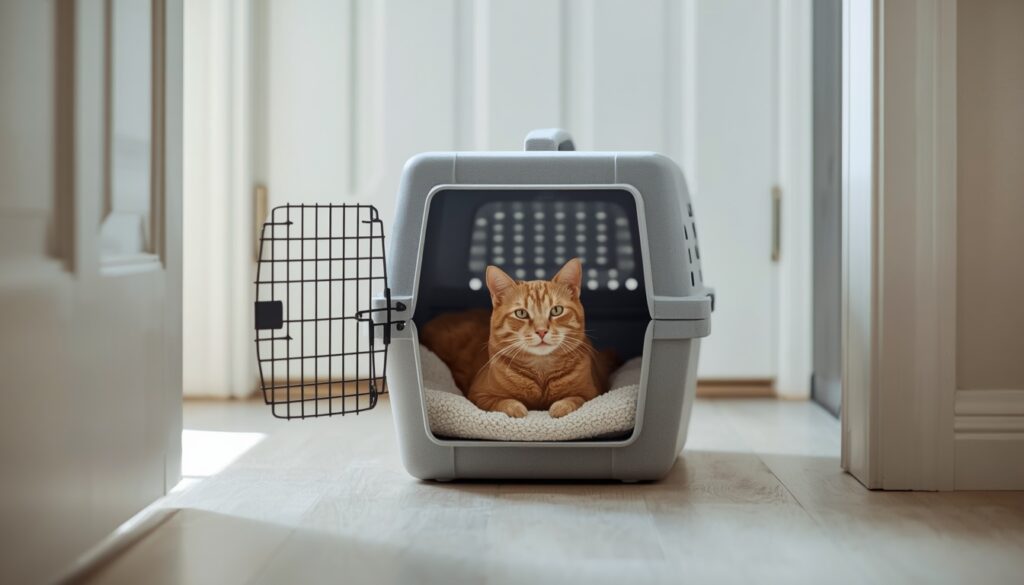
The carrier matters most on the worst day
Most cats see the carrier twice a year, if that. Then comes the evening your cat is straining in the litter box, or vomiting over and over, and you need to get out of the door in a few minutes. A carrier your cat already knows, that latches properly and that your vet can work with, makes that trip faster and calmer for both of you.
This guide covers what veterinary groups say a good carrier looks like, five carriers worth a look, and how to train a cat to accept one before you need it.
When to skip the shopping and go
If your cat is straining in the litter box with little or no urine, is crying in pain, is vomiting repeatedly, has pale gums or is struggling to breathe, do not stop to train it or order a carrier. A male cat that cannot pass urine can become critically ill within a day. See urinary blockage in cats and call a vet or an emergency clinic now. Use whatever secure container you have, line it with a towel and phone ahead.
How we chose
We have not tested these carriers hands-on. We built the list from the advice of the American Association of Feline Practitioners (AAFP), then looked for carriers that are sold in the US and whose maker or a major retailer page describes the features that advice asks for: a sturdy shell or frame, a top opening, ventilation and a way to secure it. We did not use prices, star ratings or review counts. Features and sizes change, so check the current listing and the size and weight limit before you buy.
What vets look for in a cat carrier
- Hard plastic, if you can. The AAFP describes hard plastic as the safest and easiest to clean. It holds its shape, and solid sides help many cats feel hidden.
- A top that comes off. If the lid lifts away, the vet can examine your cat while it stays in the bottom half, which is much less frightening than being pulled out through a small door.
- Top and front doors. A top opening lets you lower a nervous cat in, rather than pushing it in head first.
- Soft carriers need a large top opening and a firm frame. The AAFP says soft carriers should have a large top opening and one, ideally two, end doors, with no door that can collapse. Its position statement also asks for mesh or holes on at least two sides.
- Room to stand, turn and lie down. No more than that.
- A leak-proof base. Accidents are common when cats are scared. Pack a spare towel.
- Not a backpack, a bag or a harness. The AAFP calls backpack-style carriers too small and unstable and says a harness or collar on a leash is not a safe way to travel.
Our picks in more detail
IRIS Two Door Front & Top Access Carrier: best for vet exams
This is the carrier that best matches the AAFP checklist on paper. It is hard-sided, with a front door and a removable top access door, ventilation holes in the sides and buckles that keep the top and base together. The listing for the 23-inch size gives a weight limit of 18 lbs, which suits most adult cats.
Worth knowing: a carrier that comes apart should be latched firmly before you lift it. Carry it from underneath, as the AAFP advises, rather than by the handle alone.
Petmate Two Door Top Load Kennel: best budget hard carrier
A widely sold plastic kennel with a front door and a top door. Chewy lists it in several sizes, up to 10 lbs for the 19-inch size and up to 15 lbs for the 24-inch size. It has a channel in the floor intended to keep a pet drier if there is an accident.
Worth knowing: the listing does not say whether the top lifts off completely, so check the product details for the size you want if a removable lid matters to you. Larger cats may need the bigger size.
Frisco Two Door Top Load Plastic Kennel: best store-brand alternative
A similar plastic kennel from Chewy’s own brand, with front and top access. It suits cats that will travel in a plain, easy-to-clean shell. Chewy’s own buying guide describes its plastic cat kennels as coming apart for easy handling at the vet.
Worth knowing: as with any hard carrier, test the latches and the top before the day you need it.
Sherpa Original Deluxe Pet Carrier: best soft carrier for a calm cat
A soft-sided carrier with top and side entry, mesh panels, locking zippers and a washable liner. A strap lets you thread a seat belt through it in the car, and the maker lists a 16 lb maximum. It is also described as airline approved for most major airlines.
Worth knowing: soft carriers give less protection than a hard shell, and the AAFP lists soft carriers as acceptable only with the right openings and frame. Not ideal for a cat that fights hard, or for rough handling.
Sleepypod Air: best for car-safety focus
A soft-sided carrier with top and side entry and mesh on four sides. The maker recommends it for pets up to 18 lbs and says it has been crash-tested and certified by the Center for Pet Safety, and that it can be used as a car seat. The maker says its carriers should not be used with other brands’ accessories.
Worth knowing: the safety claim is the maker’s; the Center for Pet Safety page we read describes a 2015 carrier study that does not cover this model, so read the maker’s current testing information. It is also a smaller, snug carrier. Check your cat’s size against the inside dimensions.
Which carrier for which cat?
| Your cat | What to look for |
|---|---|
| Nervous, hides or hisses | Hard carrier with a removable top and solid sides, so the exam can happen in the base |
| Calm, relaxed with handling | A soft carrier with a large top opening can work |
| Large cat (over 15 lbs) | Check the weight limit and interior size; the larger sizes only |
| Long drives or car safety is a concern | A carrier with a stated crash-testing method, secured on the floor behind the front seats |
| Cat that has a medical condition or has been to the vet urgently before | A carrier it already sleeps in, ready by the door |
How to get your cat used to the carrier
- Put it in a living area. The AAFP says to keep the carrier somewhere the cat spends time, not in the garage or a closet.
- Make it comfortable. Add a familiar blanket or bed, and drop treats inside now and then.
- Let your cat go in on its own. Do not force it. If you need to move it, do so gently and calmly.
- Practice small steps. Close the door for a few seconds with a treat, then longer, then lift the carrier, then carry it to the car and back.
- Add short car trips. The AAFP position statement suggests short, positive test drives, built up gradually.
- Use a familiar scent. A towel from home draped over the carrier helps, and the AAFP also describes calming pheromone sprays applied to bedding well before travel, with the cat out of the room.
Using the carrier safely on the day
- Secure it in the car. The AAFP says the safest spot is the floor between the front and back seats, and a carrier should be kept level and secured with a seat belt or weights.
- Cover it. A towel over the carrier reduces what your cat sees, but keep it ventilated.
- Do not open it in the car. A frightened cat can slip out and get under the pedals.
- Do not feed right before travel. The AAFP advises against it because of motion sickness.
- Keep the car comfortable. Never leave a cat in a parked car.
- At the clinic, keep your cat in the carrier until you are in the exam room. Ask the vet to examine your cat in the base if the lid lifts off.
- Going home. If you have other cats, the AAFP suggests keeping the returning cat in the carrier at first and separating it in a quiet room if the others hiss.
Ask your vet before a trip if your cat gets very stressed or car sick. Vets can suggest options, but do not give your cat any medicine or sedative without being told to. Sedation before travel can affect balance, and the AAFP position statement advises against sedatives for routine transport.
Common mistakes
- Only getting the carrier out on vet day. Your cat learns that the carrier means a bad trip.
- Chasing a cat into a carrier. Use a top opening and lower the cat in, or take the lid off and lift the cat into the base.
- Buying too big. A roomy carrier slides in a stop.
- Using a pillowcase, a tote bag or a cardboard box as a plan. The AAFP says containers not made for animals are not acceptable.
- Waiting for the perfect carrier during an emergency. Get your cat to a vet first.
Planning for a vet visit
If you are planning a visit, our guide to how much a vet visit costs covers what to expect on the bill, and emergency vet costs explains what an urgent visit can involve. For cats prone to urinary problems, see feline idiopathic cystitis and have a plan and a carrier ready.