
 Written by
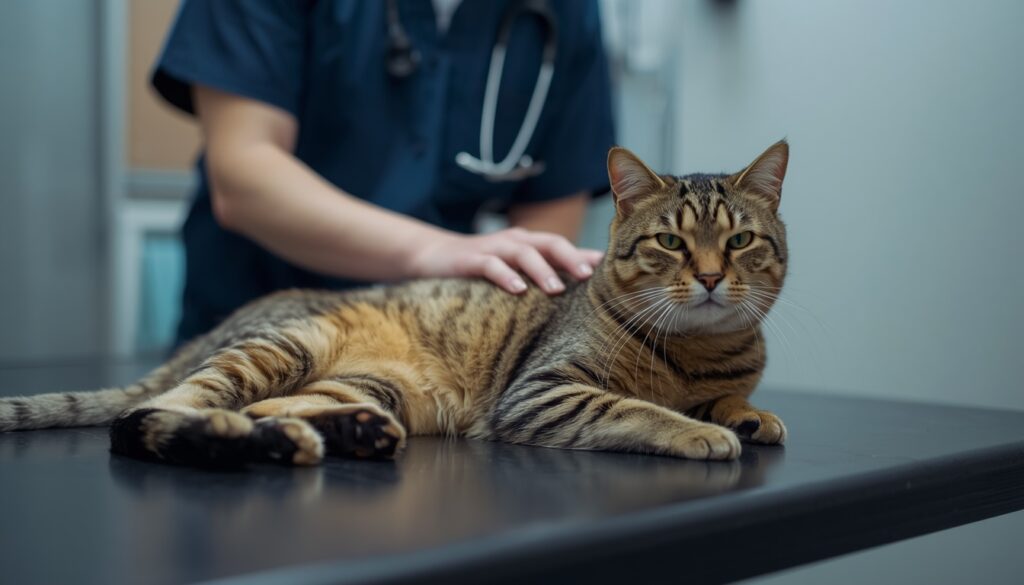
What feline idiopathic cystitis is
Feline idiopathic cystitis, or FIC, is inflammation of the bladder with no cause that a vet can find. “Cystitis” means bladder inflammation. “Idiopathic” means of unknown origin. The bladder is sore and the cat feels an urgent need to urinate, but there is no infection, no stone and no growth behind it. You may also see it called feline interstitial cystitis or sterile cystitis.
FIC is one of several conditions grouped under feline lower urinary tract disease (FLUTD). It is the most common of them. The 2025 consensus guidelines from International Cat Care (iCatCare) say that in studies over about three decades, no cause could be found in roughly 55 to 65% of cats with lower urinary tract disease, and those cats were classed as having FIC. The Merck Veterinary Manual puts it simply: most cats with lower urinary tract signs have FIC.
The name suggests a bladder problem, but vets now think of FIC as a condition of the whole cat. The iCatCare panel describes it as a disorder that involves more than the bladder, in which the bladder signs are a response to a stress system that stays switched on. That is why treatment looks beyond the bladder, to the cat’s home and daily life.
Signs of FIC
The signs are the same as for other bladder problems, which is why a vet visit is needed to tell them apart:
- Going to the litter box more often and passing only small amounts
- Straining or squatting for a long time
- Blood in the urine, or pink-tinged urine
- Crying or looking distressed while urinating
- Urinating outside the litter box
- Licking the genital area more than usual
Owners sometimes mistake straining to urinate for constipation. If you are not sure which you are seeing, treat it as a urinary problem until a vet says otherwise.
Emergency or wait? A quick guide
The main danger with any bladder problem in cats is a blocked urethra, the tube that carries urine out of the body. FIC is the most commonly reported cause of blockage, according to the iCatCare guidelines. Male cats are at much higher risk because their urethra is longer and narrower.
| What you see | What to do |
|---|---|
| Red: go now. Straining with little or no urine, repeated trips to the box with nothing produced, crying in the box, vomiting, hiding, weakness or collapse. Any male cat with urinary signs that you have not seen pass urine. | Go to a vet or a 24-hour emergency clinic immediately. Do not wait for morning. The Merck Veterinary Manual says a cat with a complete blockage may die within 2 to 3 days without treatment. Read more about urinary blockage in cats. |
| Amber: see a vet within 24 hours. Frequent small puddles, blood in the urine, straining but clearly passing urine each time, peeing outside the box, licking under the tail. The cat is still eating and behaving normally. | Call your vet and book the first available visit. The bladder is painful and the cause needs checking. Watch closely, and move to “go now” if urine stops or your cat seems unwell. |
| Green: mention at the next visit. A cat with known FIC, already checked by a vet, who has a single accident during a stressful event and is otherwise urinating normal amounts, eating and acting like themselves. | Follow the plan your vet gave you and keep a note of the date and any trigger. If signs last more than a day or two, or it is a male cat, call the vet. |
If you cannot tell whether urine is coming out, see our guide to a cat that is not peeing. When in doubt, treat it as red.
Why it happens
The exact cause is not known. The Merck Veterinary Manual says the condition seems to involve an interplay between the lower urinary tract, stress and the nerve and hormone signals that link the two. The iCatCare guidelines describe the bladder signs as a response to a threat-response system that stays active, shaped by a cat’s genes, early life and surroundings.
In plain terms, some cats are wired to react strongly to things they find threatening. When such a cat lives with ongoing stress it cannot escape, the bladder is one of the places where the strain shows up. Vets sum this up as “susceptible cats in provocative environments.”
Risk factors
The 2025 iCatCare guidelines list these risk factors:
- Genetics and early difficult experiences
- A nervous disposition, or reacting strongly to perceived threats
- An indoor-only life and an inactive lifestyle
- Obesity
- Living with other cats
- An unsettled household
- Frequent changes of diet
- Non-clumping litter
- No high places to watch from
The AAHA/AAFP Feline Life Stage Guidelines add that FIC is the most likely explanation for urinary signs in young adult and mature cats. In older cats, vets look harder for other causes. MSPCA-Angell notes that urinary infections are rare in healthy young cats and become more common after about 7 or 8 years of age.
Common triggers for a flare-up
Owners often notice a flare-up after a change: a house move, building work, a new baby, pet or partner, a stay at a boarding facility, a change in work hours, tension with another cat in the home, or outdoor cats appearing at the window. Sometimes there is no trigger that anyone can find.
What happens at the vet
There is no test that confirms FIC. The iCatCare guidelines state that no sensitive, specific test is available in practice. Instead, vets diagnose it by excluding the other causes of the same signs: bladder stones, a urinary infection, a urethral plug and, in older cats, a tumor. Here is what a typical visit involves.
- Triage. Staff will first check that your cat is not blocked. The vet feels the bladder. A large, firm bladder that cannot be emptied means an emergency, and treatment starts straight away.
- History. Expect questions about when the signs started, whether you have seen urine come out, what and how your cat eats and drinks, the number of cats and litter boxes at home, and any recent changes. These answers matter as much as the tests.
- Urinalysis. A urine sample is checked for concentration, blood, crystals and cells. The guidelines advise examining it within an hour, because crystals can form in a sample that sits or is chilled and give a misleading result. Do not be surprised if the vet prefers to collect a fresh sample in the clinic.
- Urine culture, when needed. If an infection is possible, a sample is taken straight from the bladder with a fine needle (cystocentesis) and sent to a lab to see whether bacteria grow.
- Imaging. X-rays find most bladder stones. Ultrasound shows the bladder wall and its contents. The iCatCare guidelines recommend imaging for cats that do not fit the usual picture, such as older cats, and for signs that are severe or keep coming back.
- Blood tests. These rarely diagnose FIC, but they check kidney function and overall health, and are essential in a blocked cat.
If the tests find no stone, infection or growth, and your cat fits the picture, the diagnosis is FIC. Costs depend on how many of these steps are needed; our guide to what a vet visit costs explains how clinics price exams and tests.
Treatment
Because the cause is unknown, there is no cure. The Merck Veterinary Manual describes the goal as reducing how severe and how frequent the episodes are. Treatment has two parts: getting your cat through the current flare-up, and changing things at home to prevent the next one.
During a flare-up
- Pain relief. FIC hurts. The iCatCare guidelines strongly recommend pain relief, even though the flare-up would probably pass on its own. Your vet will choose a medicine that is safe for cats. Never give human painkillers: several are poisonous to cats.
- More water. Wet food and extra water sources dilute the urine.
- Calm and routine. Keep the household quiet, keep boxes spotless and avoid new stresses while the bladder settles.
- Close watching. Check that urine is being passed, especially in male cats. Clumping litter makes this easier to see.
What helps and what does not: the evidence
| Approach | What the sources say |
|---|---|
| Changes to the home and routine (multimodal environmental modification) | Called “the standard of practice” by the 2025 iCatCare guidelines, which say it has been shown to reduce recurrence. The AAHA/AAFP guidelines cite a study in which cats followed for 10 months had significant reductions in urinary signs. |
| Pain relief | Strongly recommended by iCatCare because the condition is painful, although the individual drug types have not been formally studied in non-blocked FIC. |
| Wet food and more water | May help prevent recurrence; iCatCare notes the studies are not conclusive. Widely recommended and low risk. |
| Prescription urinary diets | One study found a urinary diet reduced the return of some signs. Diets aimed only at acidifying urine or dissolving struvite crystals are generally not needed for non-blocked FIC. |
| Pheromone diffusers | A pilot study found no significant shortening of signs. iCatCare says they may be a useful add-on but are not suitable as the only treatment. |
| Calming supplements and bladder-lining (GAG) supplements | Studied in small numbers of cats. Merck calls the evidence preliminary; iCatCare reports no significant benefit from glycosaminoglycans. |
| Steroids | No significant benefit found in cats with FIC, according to iCatCare. |
| Antibiotics | Not a treatment for FIC, which is not an infection. Used only when a urine culture shows bacteria. |
| Anti-anxiety and behavior medicines | Mixed results, per Merck. iCatCare says they may be considered in cats that do not respond to other measures, alongside changes at home and ideally with a veterinary behaviorist’s input. |
Not every cat needs every measure. The AAHA/AAFP guidelines note that vets can tailor the plan to the cat and to what the household can manage.
Changes at home that make the biggest difference
This is the core of FIC treatment. The aim is a home where your cat feels safe, has choices and can predict what happens next. MSPCA-Angell organizes the advice around the “five pillars” of a healthy feline environment.
1. A safe place
Give your cat somewhere to retreat that is theirs: a covered bed, a box, a shelf or a perch up high. Lack of a raised vantage point is a listed risk factor. Nobody, including children and other pets, should disturb the cat there.
2. Enough of everything, in separate places
Food, water, litter boxes, scratching posts and resting spots should each be available in more than one location, so a cat never has to pass another cat or a scary appliance to reach them. MSPCA-Angell notes that competition for resources is a major stressor even between cats that seem bonded.
3. Litter boxes done right
- One more box than the number of cats, placed in different locations rather than side by side
- Scooped every day
- Quiet spots with an easy escape route, away from noisy machines
- Clumping litter, since non-clumping litter is a listed risk factor
See our picks for litter boxes for cats with urinary problems.
4. More water
Feed wet food if your vet agrees, and offer water in several places. Some cats drink more from a wide bowl or a fountain; here are our cat water fountain picks. Make any food change gradually, and then stick with it.
5. Play and hunting
Short daily play sessions that let your cat chase, pounce and catch use up energy and lower tension. Tossing treats or kibble to chase, or using puzzle feeders, also helps an indoor cat stay active and at a healthy weight.
6. Predictable, gentle contact
Keep feeding times and routines steady. Let your cat choose when to be petted and when to walk away. Never punish accidents. The Merck Veterinary Manual is clear on this: punishing a cat for urinating outside the box does not help.
7. Respect the nose
Cats rely on scent to feel at home. Avoid strong cleaners and air fresheners near their resting places and boxes, and when outdoor cats are the trigger, blocking the view from that window can help.
Outlook
A single flare-up usually resolves in about 2 to 7 days. The harder part is recurrence. The Merck Veterinary Manual says about half of affected cats have another episode within a year, and some have several. MSPCA-Angell describes FIC as often a long-term condition with flare-ups rather than a one-time event, but adds that most cats improve with treatment and changes at home, and that flare-ups can become milder and less frequent over time.
For male cats, the risk of blockage stays for life. Every flare-up in a male cat deserves a call to the vet and a close watch on urine output.
Keeping a flare-up diary
Because FIC comes and goes, a simple record helps your vet see patterns that are easy to miss:
- The date each flare-up started and how long it lasted
- The signs you saw, and whether urine was passed each time
- Anything that changed in the week before: visitors, travel, a new pet, a different food or litter, building noise
- What you changed at home afterward, and whether it seemed to help
Questions to ask your vet
- What did the urine test show, and was a culture needed?
- Have stones been ruled out with X-rays or ultrasound?
- What pain relief is my cat getting, and for how long?
- Should I change the diet, and how quickly?
- Which changes at home matter most for my cat and my household?
- What exact signs mean I should come back the same day?
- If flare-ups keep happening, when would you refer us to a behavior or internal medicine specialist?
If you do not have a regular vet, you can browse vet clinics in Houston on HeiBob.