
 Written by
What bladder stones are
Bladder stones are hard lumps of minerals that form in a cat’s urine. Vets call them uroliths or calculi, and the condition urolithiasis. They can be as fine as sand or large enough to fill much of the bladder, and a cat can have one stone or many.
Urine carries dissolved minerals out of the body. When the urine is very concentrated, or its acidity suits a particular mineral, those minerals can come out of solution as microscopic crystals. Crystals can then stick together and grow into a stone. The Merck Veterinary Manual says this growth takes weeks to months, and that the reasons one cat forms stones and another does not are still not fully understood. Diet, how much a cat drinks and how often it urinates, infection, some medicines and genetics all seem to play a part.
Stones can form anywhere in the urinary tract: the kidneys, the ureters (the tubes from the kidneys to the bladder), the bladder itself, or the urethra (the tube that carries urine out). The bladder is by far the most common place. Stones are one of the conditions grouped under feline lower urinary tract disease, alongside feline idiopathic cystitis, which is more common and causes the same signs.
For a short definition, see our glossary entry on cat bladder stones. This page covers the whole picture: types, diagnosis, treatment and prevention.
Signs of bladder stones in cats
Small stones may cause no signs at all and are sometimes found by chance on an X-ray. Larger or rougher stones rub against the bladder lining and make it sore and inflamed. Typical signs are:
- Blood in the urine, or pink-tinged urine
- Going to the litter box more often and passing small amounts
- Straining, or squatting for a long time
- Crying or looking uncomfortable while urinating
- Urinating outside the litter box
- Licking the genital area more than usual
None of these signs is specific to stones. Cystitis, a urinary infection and a blocked urethra all look much the same at home, which is why a cat with urinary signs needs a vet to work out which one it is.
Emergency or wait? A quick guide
The real danger with a bladder stone is that it leaves the bladder and gets stuck in the urethra. Stones form about equally in male and female cats, according to the Merck Veterinary Manual, but males block far more often because their urethra is narrower. A complete blockage stops urine leaving the body. Merck’s owner guide says toxins build up within 1 to 2 days and a completely blocked cat can die within about 3 days.
| What you see | What to do |
|---|---|
| Red: go now. Straining with little or no urine, a few drops at a time, repeated trips to the box with nothing produced, crying in the box, vomiting, hiding, weakness or collapse. Any male cat with urinary signs that you have not seen pass urine. | Go to a vet or a 24-hour emergency clinic immediately. Do not wait for morning. Read more about urinary blockage in cats. |
| Amber: see a vet within 24 hours. Blood in the urine, frequent small pees, straining but clearly passing urine each time, peeing outside the box. The cat is still eating and behaving normally. | Call your vet and book the first available visit. Watch the litter box closely, and move to “go now” if urine stops or your cat seems unwell. |
| Green: mention at the next visit. A cat with a known history of stones, already on a vet’s plan, that is urinating normal amounts with no blood, eating and acting normally, and is simply due a recheck. | Keep to the recheck schedule and the prescribed diet. Call the vet sooner if any of the signs above return. |
If you cannot tell whether urine is coming out, see our guide to a cat that is not peeing. When in doubt, treat it as red.
The main types of stone
Stones are named after the mineral they are made of. The type matters more than anything else, because it decides whether the stone can be dissolved and what will stop the next one.
Two types make up nearly all bladder stones in cats. In a study of 3,940 cat stones analyzed at the University of California, Davis between 2005 and 2018, 47.1% contained struvite and 46.2% contained calcium oxalate. Urate was a distant third, found in 9.2%. (Some stones contain more than one mineral, so the figures overlap.)
| Type | Who tends to get it | Can it be dissolved? |
|---|---|---|
| Struvite (magnesium ammonium phosphate) | Forms in neutral to alkaline, concentrated urine. In the UC Davis study it was most often found in cats aged 4 to 10 and was more common in females. In cats it almost always forms without an infection, unlike in dogs. | Yes, usually, with a prescription diet. See also struvite crystals. |
| Calcium oxalate | Favored by acidic, concentrated urine. More common in cats aged 7 and over and in males in the UC Davis study, with Burmese and Persian cats at higher risk. A high blood calcium level is an important risk factor. | No. It has to be removed if it causes problems. |
| Urate | Linked to very acidic, concentrated urine and, in a few cats, to a liver blood-vessel defect (a portosystemic shunt). | Not reliably. The ACVIM consensus statement says there are no data on dissolving urate stones in cats. |
| Others (calcium phosphate, cystine, dried solidified blood) | Uncommon. | Generally no. |
The balance between the two main types has shifted over the years. Calcium oxalate became more common in past decades, which the UC Davis authors suggest may be linked to the strongly acidifying cat foods introduced to prevent struvite. Merck likewise notes that diets designed to control struvite may contribute to calcium oxalate stones. In the UC Davis data the trend then moved back toward struvite. The practical lesson for owners is simple: do not pick a “urinary” food yourself for a cat that has had a stone. The right diet depends on the type.
Stones, crystals and plugs
These three words are often mixed up. Crystals are microscopic and show up in a urine sample. Stones are solid and big enough to see on imaging. Urethral plugs are soft, toothpaste-like mixtures of crystals and protein that form in the urethra; Merck describes plugs as the usual cause of urethral blockage in male cats. Finding crystals in a urine sample does not prove a cat has stones. Imaging is what confirms a stone.
What happens at the vet
Your vet’s first job is to make sure your cat is not blocked, then to find out what is causing the signs.
- History and exam. Expect questions about diet, water, litter box habits and when you last saw a normal pee. The vet will feel the bladder; stones can sometimes be felt, and a large, hard, painful bladder points to a blockage.
- Urine test. A urinalysis checks how concentrated the urine is, its pH, and whether there is blood, crystals or bacteria. The pH gives a hint about stone type, since calcium oxalate is favored by acidic urine and struvite by neutral to alkaline urine, but Merck cautions that urinalysis is not a perfect predictor. A urine culture may be run to check for infection.
- X-rays. Struvite and calcium oxalate stones both show up on plain X-rays. Merck’s owner guide says X-rays can pick up stones as small as 3 millimeters.
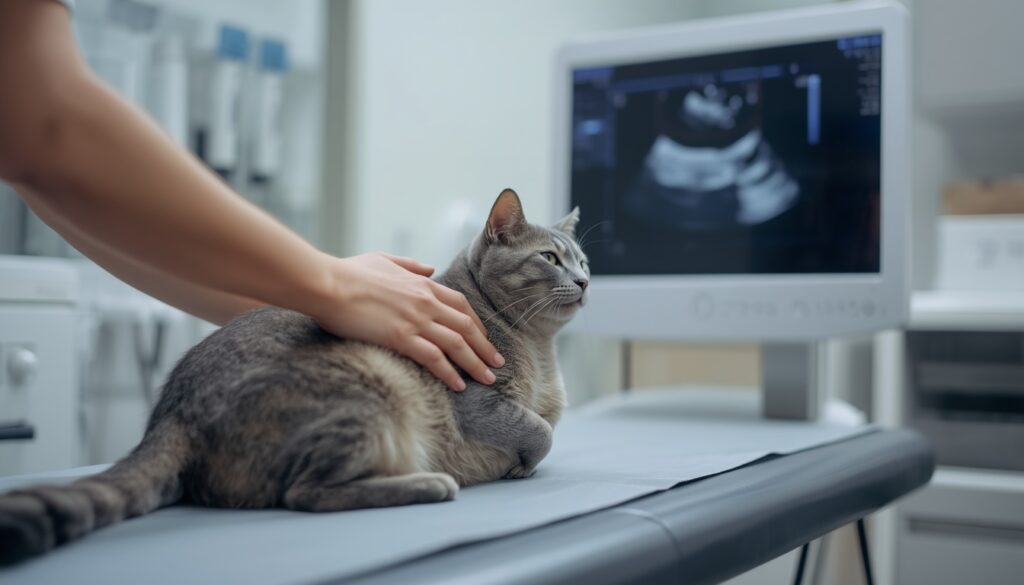
- Ultrasound. Used to find stones that do not show on X-ray, to confirm where a stone is, and to check the kidneys and ureters.
- Blood tests. These check kidney function and blood calcium. Merck advises screening cats with calcium oxalate stones for a raised ionized calcium level, because treating that changes the plan.
- Stone analysis. Any stone that is removed or passed should be sent to a laboratory. This is the only way to know the type for certain.
Before any stone has been analyzed, your vet makes an informed guess at the type from your cat’s age, the urine pH and how the stones look on the X-ray, then chooses a first step.
Treatment
Dissolving the stones with diet
If the stones are likely to be struvite, the usual first choice is a prescription diet that makes the urine more acidic and lower in the minerals struvite is built from. The 2016 consensus statement from the American College of Veterinary Internal Medicine (ACVIM) recommends dissolving struvite bladder stones medically rather than operating, unless the diet cannot be fed or the stones cannot be bathed in urine, for example during an obstruction.
Dissolution is quick when it works. The Merck Veterinary Manual says it typically happens within 2 to 4 weeks, with X-rays and a urine test repeated about every 2 weeks. The ACVIM statement gives a similar range of less than 2 to 5 weeks. If the stones have not shrunk substantially by then, they are probably not struvite, and the plan changes to removal.
The diet only works if it is the only thing your cat eats. Other foods and treats can undo the change in the urine. A dissolution trial also avoids an anesthetic and surgery, which is why vets favor it when the stone type fits.
Removing the stones
Calcium oxalate stones cannot be dissolved. Stones that are causing signs, or that fail a dissolution trial, need to come out. The options are:
- Flushing (voiding urohydropropulsion). Under sedation or anesthesia the bladder is filled with fluid and then squeezed so that small stones are flushed out through the urethra. It only works for stones small enough to pass.
- Cystoscopy with a laser or basket. A thin scope is passed up the urethra, and stones are broken up with a laser or caught in a tiny basket. The ACVIM statement prefers these less invasive methods over open surgery where they are possible, but notes that nearly all male cats have a urethra too narrow for current scopes. It is mainly a referral-hospital option for female cats.
- Surgery (cystotomy). The vet opens the bladder through a cut in the belly and lifts the stones out. This is the most widely available method and the usual one for male cats and for large stones. X-rays are normally taken afterward to confirm every stone is gone.
The ACVIM statement also says that stones causing no signs, which cannot be dissolved and are unlikely to block the urethra, do not always have to be removed. They can be monitored with repeat imaging instead, with removal if signs appear. Ask your vet whether that applies to your cat.
If a stone blocks the urethra
A blocked cat is stabilized first: fluids, pain relief and a urinary catheter to empty the bladder. A stone stuck in the urethra is usually flushed back into the bladder and then dealt with there. Surgery on the urethra itself is discouraged by the ACVIM statement where it can be avoided, because of the risk of scarring, leakage and repeat infections. Our guide to urinary blockage treatment costs explains what the hospital stay involves.
Kidney and ureter stones
Stones can also form higher up. They are much less common than bladder stones: of stones from more than 45,000 cats analyzed by the Minnesota Urolith Center in 2022 and 2023, 1.7% came from the kidneys or ureters, and 76% of those were calcium oxalate.
Most kidney stones cause no signs and are left alone. The ACVIM statement recommends removing them only if they cause obstruction, repeated infection or pain. A stone that drops into a ureter is different. It can block the flow of urine from that kidney and damage it, and the ACVIM statement treats ureteral obstruction as an emergency. Signs can be vague: vomiting, poor appetite, hiding or belly pain. Specialist hospitals treat these with stents or bypass devices placed around the blockage.
Preventing stones from coming back
Getting rid of the stone treats today’s problem. The conditions in the urine that built it are usually still there, so prevention starts the same day. The Merck Veterinary Manual describes calcium oxalate stones as expected to recur and struvite as likely to recur without a preventive plan.
- More water. Dilute urine is the single most useful change for every stone type. Wet food is the easiest way to add water; Cornell’s Feline Health Center suggests at least 50 percent of a cat’s diet should be wet food. Extra water bowls, water added to food and a water fountain can all help.
- The right diet for the stone type. Struvite prevention uses a diet that keeps the urine mildly acidic. Calcium oxalate prevention is the opposite: the ACVIM statement advises avoiding acidic urine, and Merck gives a target urine pH of 6.6 to 7.5. This is why a stone analysis matters. Read more about urinary care cat food, and feed only what your vet prescribes.
- No supplements unless your vet agrees. Merck advises avoiding certain mineral and vitamin supplements in cats prone to stones.
- Treat the cause if one is found. A raised blood calcium level or a urinary infection needs its own treatment.
- Clean litter boxes and more activity. Cornell notes that stones are more common in cats that are inactive, drink little and urinate infrequently. Play keeps a cat moving, and a clean box encourages a cat to go more often.
- Regular rechecks. The Minnesota Urolith Center’s recommendations for calcium oxalate and urate stones suggest a urine test every 3 to 6 months and imaging every 6 to 12 months, so that new stones are found while they are still small enough to flush out without surgery. Your vet will set the schedule for your cat.
Outlook
Most cats with bladder stones do well. Struvite stones usually dissolve within weeks, and stones that cannot be dissolved can be removed. The outlook is more guarded when a stone blocks the urethra or a ureter, because of the strain on the kidneys, and that is the reason to act fast on the red-flag signs above. Recurrence is the long-term challenge, and the owner’s part in it, sticking to the diet, the water and the rechecks, makes a real difference.
Questions to ask your vet
- What type of stone do you think this is, and why?
- Is a dissolution diet worth trying first? When will we repeat the X-rays?
- If the stones need removing, which method do you recommend for my cat, and will you take X-rays afterward?
- Will the stone be sent for analysis?
- Has my cat’s blood calcium been checked?
- What should my cat eat long term, and can I give any treats?
- How often should we repeat urine tests and X-rays?
- What signs mean I should go to an emergency clinic rather than wait?
If you do not have a regular vet, you can browse vet clinics in Houston on HeiBob.