
 Written by
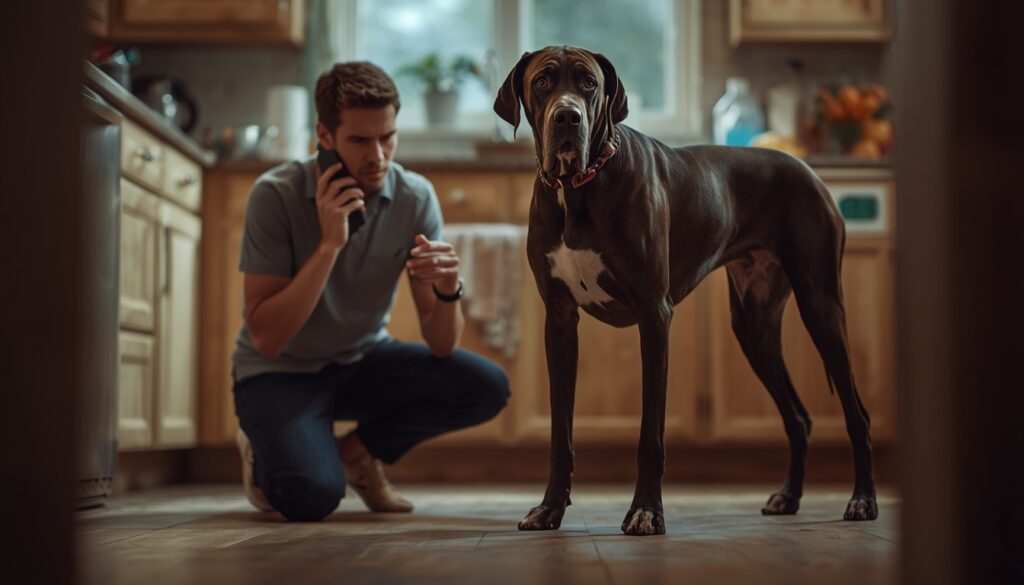
If you think your dog has bloat, do this now
- Phone the nearest open vet or emergency hospital. Say “I think my dog has bloat” and describe what you see. The team can get ready before you arrive.
- Leave straight away. Do not wait to see if the belly swells further or if your dog manages to vomit.
- Give nothing by mouth. No food, no water, no medicine, no gas-relief products.
- Do not press on the belly and do not try to make your dog vomit.
In Houston, the hospitals in our listings that stay open all night are on the 24-hour emergency vets page. If your regular vet is open and closer, call them first and ask whether to come in or go straight to an emergency hospital.
What bloat is, in plain words
“Bloat” covers two things. In the first, the stomach fills with gas, fluid or food and stretches. Vets call this gastric dilatation. In the second, the stretched stomach also rotates and twists shut. That is gastric dilatation-volvulus, or GDV. The short glossary entry on bloat and GDV has the terms.
The twist is what kills. Cornell’s Riney Canine Health Center explains that it traps the gas, cuts blood flow to the stomach wall, and lets the swollen stomach squeeze the large veins that carry blood back to the heart. The dog goes into shock. The stomach also pushes on the diaphragm, which makes breathing hard. The spleen sits next to the stomach and often twists with it. Parts of the stomach wall can die, and the heart can start to beat out of rhythm.
You cannot tell from the outside whether a bloated stomach has twisted. Only an X-ray can. That is why every dog with these signs needs a vet now, not later.
Emergency or wait? A quick guide
Red: go to a vet now
- Retching, gagging or trying to vomit with little or nothing coming up
- A belly that looks swollen or feels tight, especially just behind the ribs
- Heavy drooling with restlessness, pacing or being unable to lie down and settle
- Looking back at the belly, standing and stretching, or a “praying” pose with the front legs stretched forward and the chest low
- Fast or hard breathing, or heavy panting at rest
- Pale gums, weakness, wobbling or collapse
- Any of the above in a large, deep-chested dog, even if the belly does not look big yet
Unproductive retching on its own is enough. A University of Illinois urgent care vet describes it this way: the dog takes the posture and makes the noise, the belly heaves, and nothing much comes out. He calls it a true emergency and advises owners to get in the car and drive to the nearest emergency clinic.
Amber: call a vet now and be seen today
- Your dog ate a very large amount of food, such as a raided bag of kibble, and now has a round belly, but is comfortable, breathing normally and not retching
- Your dog brought up food or fluid once or twice and seems uneasy afterward
- A dog that has already had a gastropexy has a swollen belly or seems uncomfortable after a meal
Amber means phone now, describe what you see and follow the clinic’s advice. A stomach packed with food can still twist. If retching, drooling, pacing, pale gums or weakness start while you are on the phone or waiting, it has become red.
Green: watch at home
- A vet has examined your dog, or heard the details by phone, and told you that watching at home is fine
- Your dog passed gas or has a slightly round belly after a normal meal, and is bright, moving easily, breathing normally and not retching or drooling
There is no green category you can choose yourself once any red sign is present. If you are in doubt, call a vet. If something your dog swallowed may be the cause of the vomiting or drooling, you can also call ASPCA Animal Poison Control on (888) 426-4435 or Pet Poison Helpline on (855) 764-7661. Both are open around the clock and may charge a fee. Do not let a poison call delay the drive if bloat signs are present.
Why minutes matter
GDV moves fast. The University of Illinois says it can become fatal in as little as a few hours without treatment. Cornell states plainly that without medical and surgical care GDV is fatal.
With treatment, most dogs live. The figures vary by source, so here they are side by side:
| Source | What it reports for treated dogs |
|---|---|
| Cornell Riney Canine Health Center (updated 2025) | Survival greater than 80 percent with medical and surgical treatment |
| AKC Canine Health Foundation | Survival greater than 80 percent with prompt treatment |
| American College of Veterinary Surgeons | Death rate reported at about 15 percent |
| Merck Veterinary Manual (reviewed 2025) | Death rates from 20 percent up to 45 percent, depending on the section and the cases counted |
What pushes a dog toward the worse end is mostly delay and damage. Merck and the American College of Veterinary Surgeons both list signs lasting more than 6 hours before the dog is seen as a risk factor for death, along with needing part of the stomach or the spleen removed. The AKC Canine Health Foundation notes worse outcomes when more than five hours pass between the first signs and arrival at the hospital. The one thing an owner controls is how soon the dog gets there.
Which dogs are most at risk
Vets have reported bloat in nearly every breed, but it is far more common in large and giant dogs with deep, narrow chests. Breeds named by Merck, Cornell and the American College of Veterinary Surgeons include:
- Great Danes
- German shepherds
- Weimaraners
- Saint Bernards
- Irish setters and Gordon setters
- Standard poodles
- Doberman pinschers
- Basset hounds
Other things linked with higher risk in those sources:
- A parent, brother or sister that has had GDV
- Older age
- Eating one large meal a day, or eating very fast
- A lean body, or a nervous or fearful temperament
- Stress, such as a kennel stay or travel
- Eating from a raised bowl
- A dry food that lists oil or fat among its first four ingredients
- A spleen that was removed earlier in life
No single cause has been found, and the AKC Canine Health Foundation points out that the evidence for several diet factors is unclear. A dog with none of these can still bloat, and many high-risk dogs never do.
What happens at the vet
- Triage. A dog with suspected bloat goes straight to the treatment area. The team checks gum color, pulse, heart rate and breathing.
- Fluids and oxygen. One or more lines go into the front leg or neck veins to give fluids fast and treat shock. Pain relief is given, and often oxygen.
- X-ray. An X-ray of the belly confirms whether the stomach has twisted. Vets usually take it with the dog lying on its right side.
- Letting the gas out. The vet passes a tube down the throat into the stomach, or puts a large needle through the skin into the stomach. Both release pressure and buy time.
- Blood tests and heart trace. Blood work checks organ damage and a value called lactate. A high lactate points to poor blood flow and a greater chance that part of the stomach wall has died. An ECG watches for abnormal heart rhythms.
- Surgery. Once the dog is stable enough for anesthesia, the surgeon untwists the stomach and checks the stomach wall and the spleen. Dead stomach wall is cut out. The spleen is removed if it is badly damaged (a splenectomy).
- Gastropexy. Before closing, the surgeon stitches the stomach to the body wall so it cannot twist again.
- Hospital stay. Most dogs stay several days on fluids and pain relief with heart monitoring. The AKC Canine Health Foundation reports that about 40 percent of dogs with GDV develop an abnormal heart rhythm. Many of these settle without extra treatment.
Letting the gas out without surgery is not a fix. Merck describes the chance of it happening again as extremely high when the stomach is decompressed but not operated on.
GDV surgery with several days in hospital is one of the more costly emergencies. Ask for a written estimate when you arrive; clinics expect the question and will keep treating while you read it. Our emergency vet cost guide explains how after-hours bills are built.
After surgery: what to expect at home
- Rest and short leash walks for a few weeks while the incisions heal
- Two or three small meals a day instead of one large one, for life
- Watching for any return of the signs
A dog with a gastropexy can still fill with gas after a very large meal. The stitches should stop the dangerous twist, not the swelling. A swollen, uncomfortable dog still needs a call to the vet the same day.
Lowering the risk
Nothing removes the risk completely. These steps come from Merck, Cornell and Washington State University’s veterinary hospital:
- Feed two or more smaller meals a day, not one big one.
- Slow down fast eaters with a puzzle feeder or slow-feed bowl.
- Feed from a bowl on the floor. Avoid raised bowls unless your vet has advised one for another reason.
- Keep hard exercise away from mealtimes, both before and after.
- Keep mealtimes calm. Feed anxious dogs apart from other pets.
- Store food where your dog cannot break into it.
- Do not breed a dog that has had GDV or has a close relative with it.
Preventive gastropexy
For at-risk breeds, and for dogs with a close relative that has bloated, many veterinary surgeons recommend a gastropexy before trouble starts. It is often done during a spay or neuter, and can be done as keyhole surgery. After a dog has had GDV, Cornell and the AKC Canine Health Foundation report that gastropexy lowers the chance of a repeat from around 80 percent to under 5 percent. Washington State University adds that preventive surgery costs less than emergency treatment. Ask your vet whether it makes sense for your dog; you can find clinics near you in our Houston vet directory.
The short version
If a dog is trying to vomit and nothing comes up, treat it as bloat until a vet says otherwise. Call, then drive. For other signs you are unsure about, our guide to when to take your dog to the emergency vet goes through them one by one.