
 Written by
A closer look at anal glands in dogs
Every dog has two anal sacs, often called anal glands. They sit just under the skin, one on each side of the anus. The lining of each sac makes a strong-smelling fluid, and a narrow duct carries it to a tiny opening at the edge of the anus. The fluid is thought to work as a scent marker that tells other dogs who has been there.
In a healthy dog you never notice them. A firm stool presses on the sacs on its way out and squeezes a little fluid onto it. Some dogs also release the fluid suddenly when they are frightened or excited, which is the sharp, fishy smell many owners know.
Trouble starts when the sacs stop emptying. The Merck Veterinary Manual describes anal sac disease as the most common disease of the anal region in dogs. In a study of more than 104,000 dogs seen at UK veterinary practices, about 4.4% had an anal sac disorder recorded in a single year. Most dogs get better with simple treatment. A few cases are painful infections, and a small number turn out to be tumors, which is why a vet should check a problem that does not pass quickly.
The four kinds of anal gland problem
“Anal gland problems” covers four different conditions. They can follow one another, and they are treated differently.
- Impaction. The sac does not empty. The fluid inside thickens into a brown paste, the sac swells, and it becomes uncomfortable. This is the most common problem.
- Sacculitis. The trapped material lets bacteria overgrow, and the sac becomes inflamed or infected. It is now painful, and the contents may look like pus or contain blood.
- Abscess. If the duct is blocked while the sac is infected, pus builds up with nowhere to go. The skin beside the anus becomes red, hot and swollen. An abscess can burst through the skin and leave an open, draining hole.
- Tumors. The most common is a cancer called apocrine gland anal sac adenocarcinoma. It is much less common than the other three and mostly affects older dogs. It often causes no pain at all, so it can be missed.
Which dogs are more at risk
Any dog can have anal sac trouble, but some are more likely to.
- Small breeds. Small dogs are affected more often than large and giant breeds. In the UK study, Cavalier King Charles Spaniels, King Charles Spaniels, Cockapoos, Shih Tzus, Bichon Frises and Cocker Spaniels had higher odds than crossbreeds, while Labrador Retrievers, Border Collies, German Shepherd Dogs and Boxers had lower odds.
- Flat-faced dogs. In the same study, flat-faced (brachycephalic) dogs had 2.6 times the odds of long-nosed dogs.
- Overweight dogs. Poor muscle tone around the anus in obese dogs means the sacs are squeezed less well.
- Dogs with soft stools or constipation. Long-running diarrhea, constipation and low-fiber diets are all listed by Cornell’s Riney Canine Health Center as contributing factors. A soft stool does not press on the sacs the way a firm one does.
- Dogs with skin allergies. Food allergy and atopic dermatitis may contribute. Greasy, scaly skin conditions can also increase how much the sacs produce.
- Adult dogs. Anal sac disease is typically seen in dogs over one year old. There is no clear difference between males and females.
Signs of anal gland problems
- Scooting: dragging the rear end along the floor or grass
- Licking or biting under the tail or at the base of the tail
- A fishy smell, or brown spots where the dog has been sitting
- Holding the tail down, or flinching when the hindquarters are touched
- Discomfort when sitting down
- Straining, or seeming reluctant to pass stool
- Swelling or redness on one side of the anus
- Blood or pus on the fur near the anus, or on the floor
With a simple impaction, most dogs are itchy and uncomfortable more than sick. With an infection or abscess, pain is the main feature. Some dogs will not sit, will not let you lift the tail, or snap when the area is touched.
Tumors are different. Many cause no signs, and a vet finds a firm lump during a routine rectal exam. Some of these tumors raise the calcium level in the blood, which makes a dog drink and urinate much more than usual. Others are noticed because the dog strains or becomes constipated.
Scooting is not always the anal glands
Scooting only tells you that the rear end itches or hurts. Vets keep several other conditions in mind:
- Skin allergies and intestinal parasites, which Texas A&M’s veterinary college lists among the conditions that mimic anal gland disease.
- Perianal fistulas: long-lasting, foul-smelling open sores around the anus. They are most common in German Shepherds and are treated very differently from an anal sac problem.
- Perianal tumors: growths in the skin around the anus, more common in unneutered male dogs.
- Perineal hernia: a soft swelling below and to the side of the anus, mostly in older unneutered males, with constipation and straining.
- Rectal prolapse or a rectal polyp: tissue showing at the anus. This always needs a prompt exam.
This is the main reason not to keep having the sacs squeezed without a diagnosis. If the sacs are not the cause, expressing them will not help, and the real problem goes untreated.
Emergency or wait? A quick guide
Red: see a vet today
- A red, hot, very painful swelling beside the anus
- A hole beside the anus leaking blood or pus (a burst abscess)
- Repeated straining with little or no stool, or crying out when trying to go
- Any tissue or mass sticking out of the anus
- Straining and unable to pass urine. This is an emergency: go to a 24-hour emergency vet
- Swelling near the anus along with vomiting, refusing food or marked tiredness
Amber: book a visit in the next day or two
- Scooting or licking that has gone on for more than a day or two, or keeps coming back
- A fishy smell that returns again and again
- Mild swelling on one side, or a dog that is tender when sitting
- A small smear of blood on the fur under the tail in a dog that otherwise seems well
- A firm lump beside the anus that does not hurt, especially in an older dog
- An older dog that is drinking and urinating far more than usual
Green: watch at home
- One short scoot after a bowel movement, with no licking afterward
- A single burst of fishy smell after a fright, such as a nail trim or fireworks
What happens at the vet
An anal sac check is quick and is often done during an ordinary appointment. A typical visit goes like this:
- History. Your vet will ask how long the scooting or licking has gone on, whether it has happened before, what the stools have been like, what your dog eats, and whether there is itching elsewhere on the body.
- A look under the tail. The vet checks the skin for redness, swelling, open sores, lumps and signs of parasites.
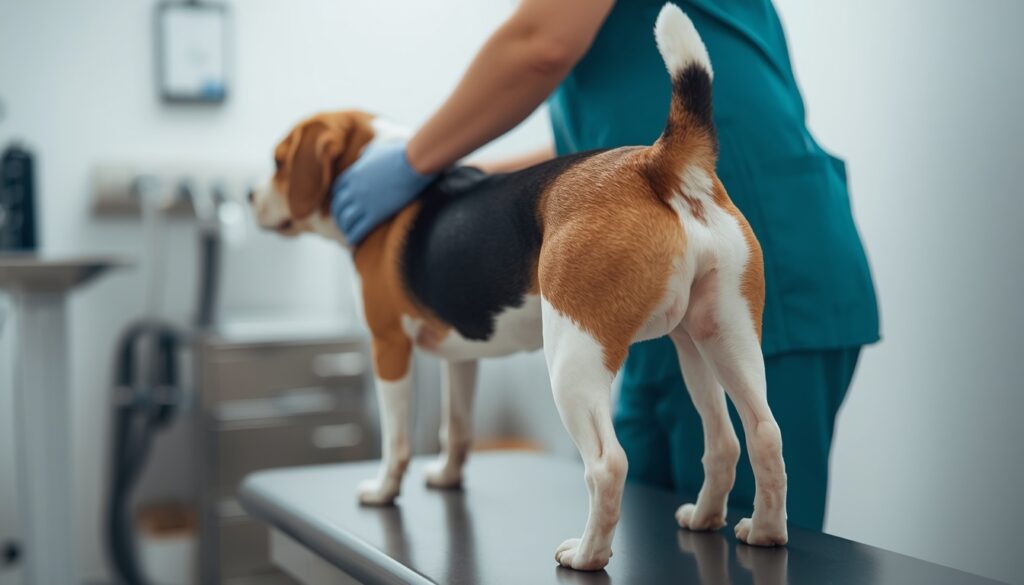
- A rectal exam. With a gloved, lubricated finger the vet feels each sac between finger and thumb. This shows whether a sac is full, hard, painful or lumpy, and it is how most tumors are found. Very sore dogs may need sedation first so the exam does not hurt.
- Expressing the sacs. If the sacs are impacted, the vet gently empties them. Material from an impacted sac is thick and brown and comes out slowly. If it is too dry to move, the vet may put saline or a softening liquid into the sac first.
- A look under the microscope. If the contents look infected, a sample can be checked for bacteria, yeast, white blood cells and red blood cells. For infections that keep returning, a culture shows which bacteria are present and which antibiotics will work.
- Further tests if a lump is found. A sac that is firm, enlarged and will not empty raises suspicion of a tumor. Next steps can include an ultrasound, a needle sample or biopsy, and a blood test that includes calcium.
Treatment
Impaction
Emptying the sacs is often all that is needed. Your vet may suggest changes to help keep them emptying on their own: more fiber, a firmer stool, or weight loss.
Sacculitis (infection)
The vet flushes the sac with saline or an antiseptic, then usually fills it with an ointment that combines an antibiotic and a steroid. Some dogs need this repeated, often a week apart, and some also need antibiotics or anti-inflammatory medicine by mouth. Sore dogs may be sedated for the flush.
Abscess
An abscess that has not burst is opened and drained, usually under sedation or anesthesia. The area is clipped and cleaned. Your dog goes home with antibiotics and pain relief, and often a cone collar so the wound is not licked. Your vet may ask you to hold warm compresses on the area for the first few days. Only use medicines your vet has prescribed for your dog. Many human pain relievers are dangerous to dogs.
Treating the cause
If allergies, long-running diarrhea or extra weight are behind the problem, the sacs will keep filling until that is dealt with. Expect your vet to talk about a diet trial, allergy control or a weight plan as well as the sacs themselves.
How often is each treatment used?
The UK study gives a sense of proportion. Among dogs with anal sac disorders, about one in five was prescribed an antimicrobial and about one in eight a pain reliever. Surgery to remove the sacs was done in fewer than 1% of cases.
Should anal glands be expressed routinely?
For most dogs, no. Cornell’s Riney Canine Health Center says routine expression is not recommended for every dog. It is something a vet may advise for dogs that have had repeated problems, to stop the sacs from becoming impacted again.
If your dog has never had a problem, there is nothing to gain from having the sacs emptied at every grooming appointment. If your dog does need regular emptying, ask your vet how often, and who should do it. Texas A&M’s veterinary college advises letting a veterinarian decide the safest method for your dog. If you are shown how to do it at home, stop and call the clinic if the area is red, swollen or painful, or if what comes out is bloody or looks like pus.
Surgery to remove the anal sacs
An anal sacculectomy removes one or both sacs. Vets consider it when infections or impactions keep returning despite good medical treatment, and it is the main treatment for tumors.
The sacs sit beside the muscle that keeps the anus closed and close to the nerves that control it, so the surgery carries real risks. The Merck Veterinary Manual lists loss of bowel control from nerve damage, long-lasting draining tracts if part of a sac is left behind, and scarring that makes passing stool difficult. Cornell also lists infection. These risks are the reason removal is not offered as prevention in dogs with healthy sacs.
After surgery, the American College of Veterinary Surgeons describes a cone collar for 10 to 14 days, about two weeks of limited activity, and stool softeners until the swelling settles.
Anal sac tumors
Anal sac adenocarcinoma is uncommon, but it is the reason vets take a firm lump beside the anus seriously. Cornell notes that affected dogs average about 10 years of age, that males and females are affected equally, and that some dogs show no signs at all.
When there are signs, they include a swelling near the anus, straining, constipation, tiredness, poor appetite, and increased thirst and urination from high blood calcium. Diagnosis needs a needle sample or biopsy. Because this cancer can spread to lymph nodes inside the abdomen, vets also recommend blood tests, chest X-rays and an abdominal ultrasound before planning treatment. Surgery is the main treatment. Radiation and chemotherapy are sometimes added.
The outlook varies a lot with the size of the tumor and whether it has spread, so ask your vet or a veterinary oncologist what applies to your dog. What owners can do is make sure a rectal exam is part of the yearly checkup. Cornell recommends one at least once a year, and twice a year for older dogs. Tumors found small have a better outlook.
Recovery and outlook
For impaction, infection and abscess, the outlook is good. Most dogs are comfortable again soon after the sacs are emptied or the infection is treated. The frustrating part is recurrence: some dogs need the sacs checked every few weeks or months, at least until the underlying cause is under control.
Go back to your vet if the scooting returns within days, if a drained abscess is not clearly healing, or if your dog is still sore after finishing the medication.
Prevention
- Aim for firm, formed stools. Ask your vet whether added fiber would help. Our guide to fiber supplements for dogs explains the options to discuss.
- Keep your dog lean. Weight loss is one of the two steps Cornell names as helpful, along with fiber.
- Deal with diarrhea and constipation that last more than a few days.
- Control skin allergies. If your dog also has itchy skin, paws or ears, ask about an allergy work-up.
- Keep up with regular checkups and ask for the anal sacs to be checked, especially in older dogs.
What treatment involves
Costs vary widely between clinics and cities, so we do not quote prices here. This table shows what each level of treatment usually includes, so you can ask a clinic for an estimate.
| Situation | What it usually involves |
|---|---|
| Simple impaction | Exam or technician visit, rectal exam, and emptying the sacs. |
| Infected sacs | Exam, a sample checked under the microscope, flushing and filling the sac with ointment, medication to take home, and one or more repeat visits. |
| Abscess | Exam, sedation or anesthesia, clipping, draining and cleaning, antibiotics, pain relief, a cone collar and a recheck. |
| Repeated problems | Culture testing, a plan for diet, weight or allergies, scheduled sac checks, and possibly referral to a surgeon for removal. |
| Suspected tumor | Needle sample or biopsy, blood tests including calcium, chest X-rays, abdominal ultrasound, surgery, and follow-up with an oncologist. |
For exam fees, see how much a vet visit costs. Some clinics publish their exam fees, which you can see on their HeiBob listings: browse vets in Houston.
Questions to ask your vet
- Were the sacs impacted, infected, or normal?
- Did both sacs feel the same? Was there any lump or thickening?
- What do you think is causing the problem: stool quality, weight, allergies, or the shape of the sacs?
- Should I change the diet or add fiber? Which type, and how much for my dog?
- Does my dog need the sacs emptied on a schedule? How often, and who should do it?
- Which signs mean I should come back sooner?