
 By
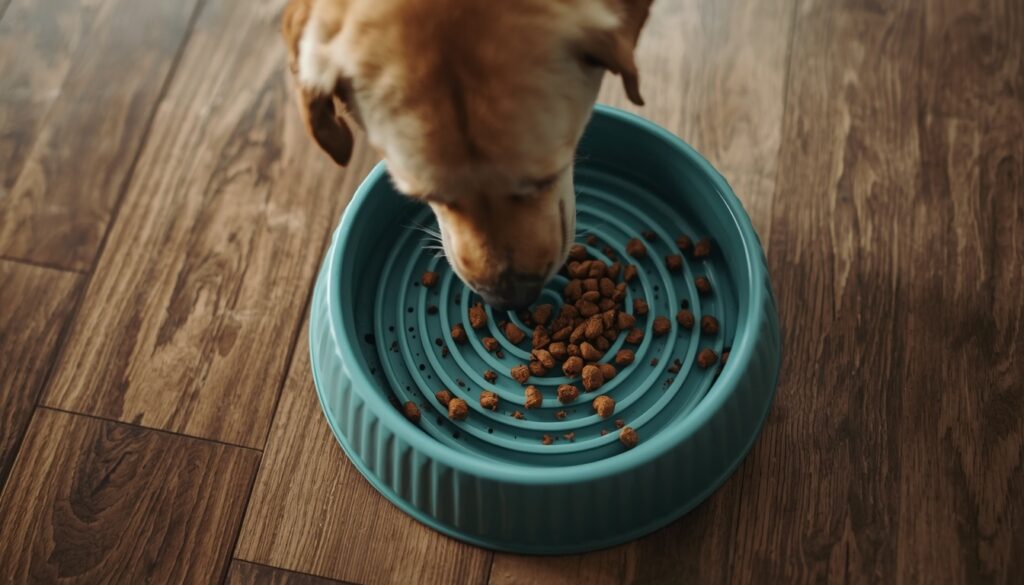
What a slow feeder does, and what it does not
A slow feeder is a bowl or toy that makes your dog work around ridges, mazes or a rolling mechanism to reach the food. The aim is simple: a meal that used to vanish in thirty seconds takes a few minutes. That can mean less gulping, less gagging and less food coming straight back up, and it gives a bored dog something to do.
Slow feeders are often mentioned alongside bloat (gastric dilatation and volvulus, or GDV), so it is worth being clear. Veterinary sources list eating very fast and one large meal a day among the factors that may raise the risk. But they also say the cause is complex and unproven, and none of the sources we read says that a bowl prevents it. Think of a slow feeder as a good mealtime habit, not as protection.
Who needs one, and who should see a vet instead
A slow feeder is a reasonable choice for a healthy dog that gulps, swallows air, or sometimes brings up a meal soon after eating. It also suits dogs that finish quickly and then beg for more, or dogs that need something to do while you are busy.
Talk to your vet before relying on one if:
- Your dog is a large or deep-chested breed. The Merck Veterinary Manual lists breeds such as Great Danes, German Shepherds, Standard Poodles and Saint Bernards as being at higher risk of GDV, and a vet can discuss feeding routines and preventive surgery.
- A close relative has had bloat.
- Your dog often retches, vomits after meals, loses weight or eats with obvious pain. Those are reasons for an exam, not a different bowl.
- Your dog has sore teeth, a flat face, or a very small muzzle.
If your dog retches with nothing coming up, has a tight, swollen belly, drools, paces or seems suddenly unwell after eating, do not wait. Go to the nearest emergency vet now. Our Houston 24-hour emergency vet list and the guide to when to go to the emergency vet can help.
How we chose
We have not tested these products hands-on. We shortlisted slow feeders that are made for dogs, sold in the US, come from known makers, and state what they are made of and how to clean them on the maker’s or a major retailer’s own page. We chose a spread of styles because the best one depends on your dog: a gulping Labrador, a small dog and a flat-faced breed want quite different feeders. Ask your vet if you are unsure.
What to look for
- Ridges that suit your dog’s face. Flat-faced breeds and small dogs do better with wide, shallow patterns. Deep, tight mazes can be frustrating.
- Material. Plastic, rubber, silicone, stainless steel and ceramic all exist. Check the maker says the material is food-safe, and think about how hard your dog chews.
- Non-slip base. A bowl that skids across the floor makes meals harder for everyone.
- Easy cleaning. Ridges trap food. Look for a bowl you can wash thoroughly or put in the dishwasher.
- Right size. The bowl should hold a full meal without piling food over the top.
- Floor level. Cornell and the Merck Veterinary Manual both advise avoiding raised bowls, so a slow feeder that sits on the floor fits that advice.
Our picks in more detail
Outward Hound Fun Feeder Slo-Bowl: best all-round
This is probably the best-known slow feeder bowl in the US. It is a plastic bowl with raised ridges and a non-slip base, sold in different sizes and patterns, from simple waves to more complicated mazes. Retail listings describe it as BPA-free and top-rack dishwasher safe.
Worth knowing: it is plastic, so it is not for dogs that chew their bowls. Some owners report flat-faced dogs struggling to reach food in deeper patterns, so choose a simple one for those breeds.
LickiMat Wobble: best for gentle chewers who like a challenge
The Wobble is made from natural rubber and moves as your dog eats, which adds a small puzzle. The maker lists it as dishwasher safe. It can also hold wet food or a spread.
Worth knowing: because it moves, it suits dogs that are happy to nudge their food around. A dog that tends to flip bowls may carry it across the kitchen.
KONG Wobbler: best for kibble-fed dogs that like to work
The KONG Wobbler is a weighted toy you fill with dry food. Your dog pushes it over and it wobbles, releasing kibble gradually. KONG lists it as dishwasher safe and sells a small size for dogs up to about 20 lb and a large one for roughly 30 to 65 lb.
Worth knowing: KONG says it is not a chew toy and should only be used under supervision. It is a good fit for a dog that is happy to chase food around the floor, but a poor one for a dog that gets frustrated.
Brightkins Circle 2-in-1: best for wet food
A ridged bowl with a removable silicone lick mat. You can spread wet food, yogurt-style toppings or a paste across the mat, which slows eating by licking rather than gulping. It is listed as suitable for dogs of all sizes.
Worth knowing: check that what you spread is safe for dogs. Never use anything containing xylitol, and see our guide on what to do if a dog eats xylitol.
A muffin tin or baking tray: best no-cost option
The American Kennel Club lists spreading kibble across a muffin tin or a cookie sheet as a simple way to slow a fast eater. It costs nothing, and you can try it before spending anything.
Worth knowing: use it for supervised meals only, and put the tin on a mat so it does not slide. A metal tin can be noisy.
Which feeder for which dog?
| Your dog | What to try |
|---|---|
| Gulps kibble from a bowl | A floor-level ridged bowl with wide, low ridges |
| Eats wet food | A lick mat or a ridged bowl with a lick mat insert |
| Bored, loves to chase food | A rolling or wobbling feeder, used with supervision |
| Flat-faced breed | A simple, wide, shallow pattern, or a lick mat |
| Chews bowls | No plastic or rubber feeder unattended: spread food on a tray, or hand-feed |
| Large, deep-chested breed | Ask your vet about the whole feeding routine first |
Using a slow feeder safely
- Start simple. Begin with an easy pattern so your dog does not get frustrated, then move up if your dog masters it.
- Watch the first meals. Check your dog is eating, not chewing the bowl or giving up.
- Split the day’s food. Cornell and the Merck Veterinary Manual both suggest more than one meal a day for dogs at risk of bloat. Ask your vet how to divide your dog’s food.
- Keep mealtimes calm. Feed dogs in separate spots, and give your dog a quiet rest after meals instead of hard play. Both sources list exercise close to mealtimes as something to limit in at-risk dogs.
- Wash after use. Old food in ridges goes sour and can put dogs off their meals.
- Replace damaged feeders. Cracked or chewed plastic and rubber can have sharp edges or break off in pieces.
Common mistakes
- Treating it as bloat prevention. A bowl is not a substitute for knowing the signs and having a plan. Read our guide to bloat in dogs.
- Using a raised stand. Cornell and Merck both advise avoiding raised bowls.
- Picking a maze that is too hard. A frustrated dog can give up, gulp from the floor or chew the bowl.
- Skipping the vet when eating habits change. A dog that suddenly eats very fast, or drops food, may have a dental or medical problem. See our guide to what a vet visit costs to plan ahead.
Other ways to slow a fast eater
A feeder is one tool. The American Kennel Club also suggests food puzzles, a two-bowl set-up where a small bowl sits upside down inside a larger one, and hand-feeding a few pieces at a time. None of these needs a purchase, and you can combine them with a feeder.
- Hand-feed part of a meal. It slows the pace and doubles as training practice.
- Scatter some kibble on a clean tray or mat. Sniffing out pieces takes time.
- Use part of the day’s food for training. Small rewards through the day can replace one big bowl.
- Separate dogs at mealtimes. Dogs that compete for food often eat faster. Feed them apart so nobody feels rushed.
When fast eating is a sign of something else
Some dogs eat fast simply because they always have. Others change suddenly. A dog that has become ravenous, is losing weight, drinks much more than usual or has loose stools needs a vet check; so does a dog that drops food, chews on one side or paws at the mouth, which can point to a dental problem. Puppies and dogs recovering from illness may also need a different feeding plan. In all of these cases, fix the cause first and choose the bowl second.
Finally, get your dog’s weight, diet and feeding routine checked at routine visits. Your vet can tell you how many meals a day suit your dog’s breed, age and health, and whether a conversation about bloat risk is worth having.