
 By
Home care helps; it does not replace the dentist
Dental disease is very common in cats. Cornell’s Feline Health Center cites studies reporting that 50 to 90 percent of cats older than four have some form of it, with gingivitis, periodontitis and tooth resorption the most common kinds. Cornell also says that between 30 and 70 percent of cats show some sign of resorption, the most common cause of tooth loss in cats.
Products can slow the build-up of plaque and tartar between professional exams. They cannot reverse gum disease or fix a damaged tooth. If you are looking at a quote for a cleaning, see our guide to what a cat dental cleaning costs.
How we chose
We have not tested these products hands-on. Every product below appears on the Veterinary Oral Health Council (VOHC) accepted products list for cats, in the table the council last updated in August 2026, and each is sold in the US by its maker or through major retailers. We then read each maker’s product page for the life stage, feeding amount and cautions. VOHC acceptance covers a plaque or tartar claim only. It is not a guarantee that a product is right for every cat, so your vet’s advice about your own cat comes first.
We left out the Healthy Mouth products, even though they are on the list. In October 2025 the VOHC reported that the company had lost its facility and warehouse in the California wildfires, and we could not confirm they are in stock today.
Who this guide is for, and who should see a vet first
These products suit adult cats with healthy mouths, and cats whose vet has cleaned their teeth and said home care can start. Cats hide pain well. The Feline Veterinary Medical Association says many cats keep eating despite dental pain, so do not rely on appetite as a sign that all is well. See a vet instead of buying a product if your cat has:
- Bad breath that does not go away
- Red, swollen or bleeding gums
- Drooling, or pawing at the mouth
- Chewing on one side, dropping food, or turning the head while eating
- A swollen face, weight loss, or eating less
A cat that stops eating is also a reason to call your vet promptly: see our note on cats that are not eating.
What to look for
- The VOHC seal. Check the product name against the VOHC list. Marketing claims such as “clinically proven” are not the same thing as acceptance.
- The right life stage. Hill’s, for example, does not recommend its adult oral care food for kittens or for pregnant or nursing cats.
- A fair share of daily calories. Purina says its dental treats should be no more than 10 percent of daily calories, with the meal reduced to compensate.
- A form your cat will accept. A treat that gets ignored does nothing. Powder, food or a wipe may suit a fussy cat better.
Our picks in more detail
Hill’s Science Diet Adult Oral Care: best dental food
This is a complete adult dry food, not a treat, so it replaces part or all of the daily meals instead of adding calories. Hill’s says its kibble texture works like a toothbrush as the cat chews, and VOHC lists the food for both plaque and tartar. Hill’s states that feeding tests support the food as complete and balanced for adult maintenance.
Worth knowing: a cat with kidney disease, urinary problems or another condition on a vet-prescribed diet should not switch foods without checking with the vet.
Feline Greenies Dental Treats: best known treat
A crunchy treat sold in several flavors, listed by VOHC for tartar. A retailer page lists about 1.4 calories per piece, which is small, but the pieces add up if you hand them out through the day. The maker’s retail page describes the treats as for adult cats.
Worth knowing: follow the feeding directions on the bag, and count the treats as part of the day’s food.
Purina DentaLife Daily Oral Care Cat Treats: best easy-to-find treat
A porous, crunchy treat that VOHC lists for tartar. Purina’s page gives a daily amount for adult cats of 5 lb or more, and says not to feed it to cats under 5 lb. It also lists about 1.4 calories per piece.
Worth knowing: treats work only if the cat chews them. A cat that swallows them whole is not getting the benefit.
ProDen PlaqueOff Powder for Cats: best for cats that refuse treats
A kelp powder you sprinkle on your cat’s usual food. Its maker says to allow about four weeks of daily use to see a difference and that it does not remove tartar that has already hardened. VOHC lists it for plaque and tartar.
Worth knowing: kelp is naturally high in iodine. The maker says cats with thyroid problems or iodine sensitivity should not use it without checking with a vet, and the same goes for cats on medication.
Cat toothpaste and finger brush: best for brushing
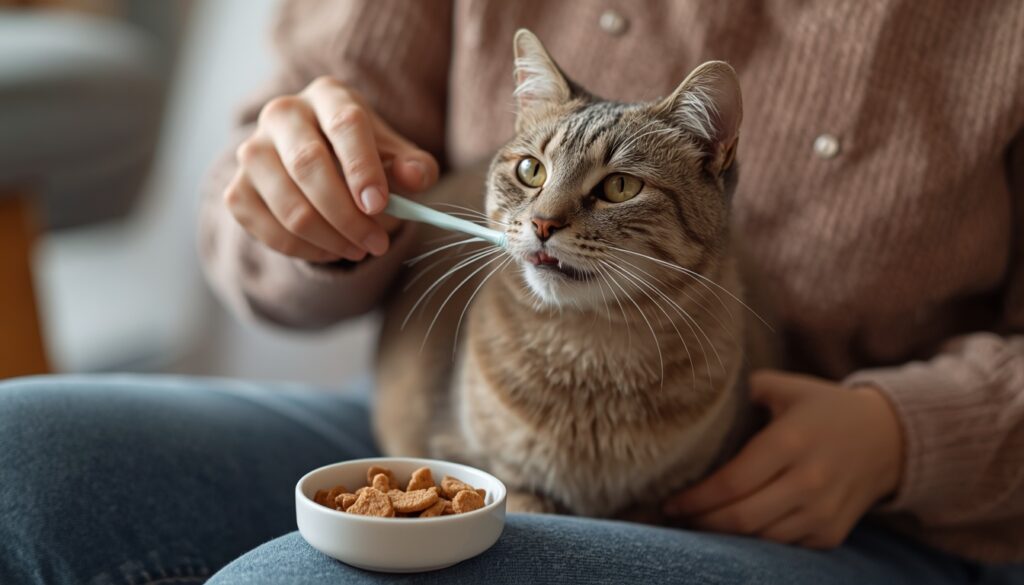
Vet groups agree that brushing is the best home care, if your cat will allow it. Cornell’s step-by-step plan takes four weeks: let the cat taste the toothpaste, then the brush, then brush the outer surfaces gently, because the tongue cleans the inside. Use a toothpaste made for cats; Cornell says human toothpaste is not safe.
Worth knowing: brushing inflamed gums hurts, which is why the AAHA warns that it can make an animal resist. If the gums are red, see a vet first. Some cats accept dental wipes better than a brush, according to the Feline Veterinary Medical Association.
Which product for which cat?
| Your cat | What to try |
|---|---|
| Healthy mouth, happy to be handled | Brushing with cat toothpaste, built up slowly |
| Won’t be brushed but eats crunchy treats | A VOHC-accepted dental treat, counted as part of the day’s food |
| Eats only one food | Ask your vet whether a VOHC-accepted dental food can replace it |
| Fussy about treats and food changes | A powder on the usual food, if your vet agrees |
| Kitten, or on a prescription diet | Ask your vet before starting anything |
| Bad breath, red gums, drooling or dropping food | No product yet: see a vet |
How to use dental products safely
- Get the mouth checked first. A cat with painful teeth needs treatment before home care.
- Add one thing at a time. If your cat has a stomach upset, you will know what caused it.
- Count the calories. Dental treats are treats. Reduce the meal if you give them daily.
- Offer fresh water. Purina’s page reminds owners to provide fresh water daily.
- Watch your cat chew. Check the first few times that the treat is being crunched, not swallowed whole.
- Keep up the vet checks. The Feline Veterinary Medical Association suggests dental checkups every 6 to 12 months, depending on age.
Starting a brushing routine
Cornell’s Feline Health Center lays out a gradual plan, so do not expect to brush on day one. Short, calm sessions work better than a struggle.
- Week one: let your cat lick a little cat toothpaste from your finger, once a day, and finish with a treat.
- Week two: put the toothpaste on the brush or finger brush and let your cat taste it.
- Week three: lift the lip and touch the brush to the outer surfaces of a few teeth, then stop while your cat is still relaxed.
- Week four onwards: brush the outer surfaces gently, working back from the front. You do not need to open the mouth wide, because the tongue cleans the inside surfaces.
The Feline Veterinary Medical Association adds that wipes are often better tolerated than a brush and suggests approaching your cat from behind and the side. If your cat is in pain or fights it, stop and ask your vet.
What the vet does that a product cannot
A professional dental visit checks the whole mouth, including below the gumline where most disease starts. The Feline Veterinary Medical Association says a real cleaning needs anesthesia, which lets the vet probe, take X-rays and clean safely. Teeth with resorption or severe disease are often removed, which is why many cats come home with fewer teeth and a more comfortable mouth. Home care is what you do between those visits to keep the mouth healthier for longer.
If you are not sure whether your cat needs a visit, a call to your vet’s front desk is a fair place to start. Our guide to what a vet visit costs explains what an exam usually includes.
Common mistakes
- Treating bad breath with a product. It can be a sign of dental disease that needs a vet.
- Expecting tartar to come off. Chews, food and powders slow new build-up; they do not remove what is already hard.
- Using human toothpaste. It is not safe for cats.
- Choosing anesthesia-free cleaning to save money. The Feline Veterinary Medical Association says it is not safe or effective.
- Waiting for your cat to stop eating. Many cats keep eating through the pain.
The same principles apply to dogs: see our dog dental care guide and what a dog dental cleaning costs.