
 Written by
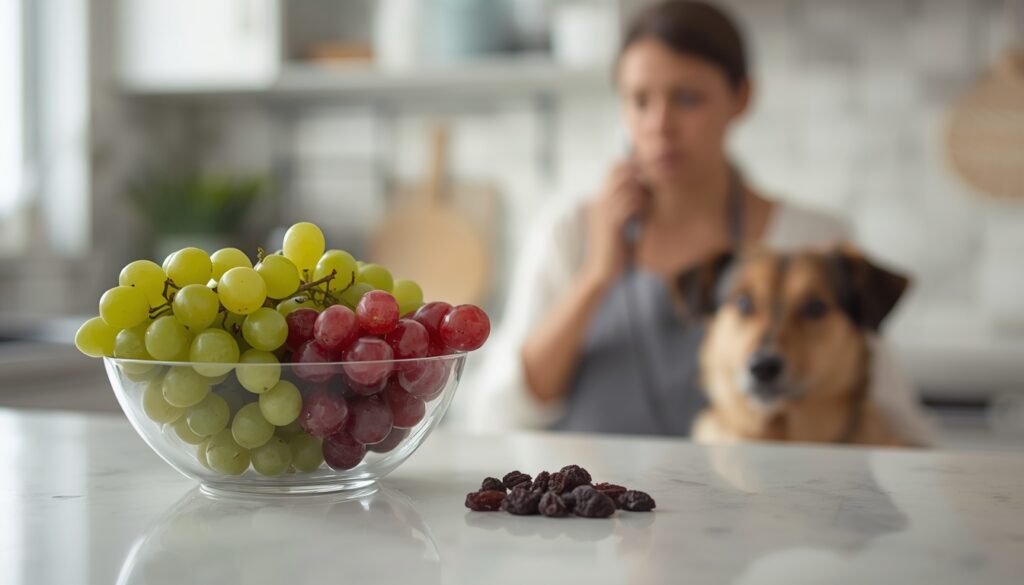
First, do these four things
- Take the rest away and check what is missing. Count or estimate how many grapes or raisins are gone, and keep the package.
- Call now. Phone your vet or an emergency hospital, or a pet poison line: ASPCA Animal Poison Control on (888) 426-4435 or Pet Poison Helpline on (855) 764-7661. Both are open around the clock and may charge a fee.
- Have the facts ready: your dog’s weight, what it ate, about how much, and when.
- Do not make your dog vomit, and do not give food or water, until the vet or poison line has told you what to do.
Do not wait for your dog to look sick. The aim is to act before the kidneys are harmed, and that window is in the first hours. In Houston, the hospitals in our listings that are open all night are on the 24-hour emergency vets page.
Emergency or wait? A quick guide
Red: call and go to a vet now
- Your dog ate grapes, raisins, sultanas or Zante currants, or food with them in it, and you cannot be sure the amount was tiny for its size
- A small dog ate any at all
- Vomiting or diarrhea after eating them
- Low energy, not eating, a sore or swollen belly
- Drinking and urinating far more than normal, or passing little or no urine
- Weakness, wobbling, tremors or seizures
- Your dog already has kidney disease
Amber: call a vet or poison line now and follow their advice
- A large dog ate a single grape or raisin and is acting normally
- You are not sure whether your dog ate any
- Your dog ate something that might contain raisins or cream of tartar, and you need the label checked
Amber still means a phone call today, right away. The vet or poison line may say to come in, or to watch at home with clear instructions. Let them make that call.
Green: watch at home
- A vet or poison line has assessed your dog’s weight and what it ate, and told you home monitoring is enough
- Your dog had only a product VCA lists as not linked to this poisoning, such as grape jelly made from juice concentrate, and is well
There is no green category you can choose on your own for real grapes or raisins. If you are in doubt, call.
Why grapes are dangerous to dogs
Grapes and raisins can cause sudden kidney failure in dogs. For years nobody knew why. The leading explanation now is tartaric acid, a natural acid in grapes. The ASPCA Animal Poison Control Center reported in 2022 that a dog fell ill with kidney injury after eating homemade playdough made with cream of tartar, a form of tartaric acid. Its team then found matching cases involving cream of tartar and tamarind, with the same signs and the same kidney damage seen in grape poisoning.
The Merck Veterinary Manual explains that dogs clear this kind of acid poorly, so it can build up in kidney cells. Not every source treats the question as settled; VCA still describes the cause as unknown.
Why nobody can tell you a safe number
- The fruit varies. The ASPCA reports that tartaric acid in grapes ranges from about 0.35% to 2%, depending on the grape.
- Dogs vary. Some dogs eat grapes and stay well. Others are harmed by a small amount. VCA says there is currently no way to predict which dogs are more at risk.
- The rough guide is very low. Merck’s general guideline is that more than one grape or raisin per 10 pounds of body weight may be enough to pose a risk to the kidneys.
So the fact that your dog ate grapes before and was fine tells you little about this time.
What counts, and what does not
| Treat as dangerous | Not linked to this poisoning, per VCA |
|---|---|
| Grapes of any kind: red or green, seeded or seedless, store-bought or homegrown, organic or not | Grape juice |
| Raisins and sultanas | Jelly made from grape juice concentrate |
| Zante currants (the small dried “currants” used in baking, which are grapes) | True currants, such as black currants, which are a different plant |
| Foods containing them: raisin bread, oatmeal raisin cookies, trail mix, granola bars, cereal, fruitcake, some chocolate assortments | Grape seed extract |
| Grape pressings from winemaking | Grape vine leaves |
| Tamarind and cream of tartar, including homemade playdough | Wine (not a grape-poisoning risk, but alcohol is harmful to dogs) |
Sources: VCA Animal Hospitals; Cornell Riney Canine Health Center; Merck Veterinary Manual; ASPCA Animal Poison Control Center. Baking does not make raisins safe, as far as any of these sources say. Raisin foods often carry a second hazard: chocolate-covered raisins add the risk covered in my dog ate chocolate, and sugar-free baked goods may contain xylitol (see my dog ate xylitol).
Signs of grape poisoning, and when they start
| Time after eating | What you may see |
|---|---|
| First hours | Often nothing. Some dogs show no early signs. |
| About 6 to 24 hours | Vomiting, the most common sign, sometimes with pieces of fruit; diarrhea; drooling; not eating; low energy; a sore belly |
| About 1 to 3 days | Signs of kidney injury: heavy thirst and urination, then little or no urine; dehydration; weakness or wobbling; swollen legs; ammonia-smelling breath; tremors or seizures |
Sources: Cornell Riney Canine Health Center; Merck Veterinary Manual; VCA Animal Hospitals. Merck puts the first vomiting or diarrhea at 6 to 12 hours for most dogs and kidney failure within 24 to 72 hours.
By the time the later signs appear, the kidneys are already damaged. That is why every source says the same thing: do not wait for signs.
What happens at the vet
- Questions and an exam. What was eaten, how much, when, and your dog’s weight. There is no lab test for grape poisoning; the diagnosis rests on what the dog ate.
- Making your dog vomit. If your dog is still well, the vet gives a medicine to empty the stomach. Cornell notes that fruit can stay in the stomach for hours, so this can help even when some time has passed.
- Activated charcoal, sometimes. Some vets give it afterwards. Merck notes that how well it works for grapes is unknown.
- Blood and urine tests. These set a baseline for the kidneys. Early results can be normal, so Cornell says vets may repeat them over two to three days.
- Fluids into a vein. For larger amounts, or once vomiting or diarrhea has started, Merck recommends intravenous fluids for at least 48 hours to protect the kidneys, with kidney values and urine output tracked throughout. Expect a hospital stay of about two days or more.
- Support. Anti-nausea and stomach-protecting medicines as needed.
- If the kidneys fail. Vets may use medicines to try to restart urine flow. Dialysis is an option in severe cases, though Cornell notes it is usually available only at specialty or university hospitals.
There is no antidote, so treatment is about getting the fruit out and protecting the kidneys. Ask for an estimate at the start; clinics expect the question. Our guide to what a vet visit costs explains how exam and emergency fees are usually charged.
Outlook
- Treated early, before kidney damage: generally excellent, according to Cornell.
- Kidney damage has begun: serious. Cornell says many of these dogs do not survive, and those that do may have long-term kidney problems that need follow-up blood tests.
- The dog has stopped making urine: poor. Merck states that most such dogs die or are euthanized, even with intensive care.
The gap between the first and last line is the reason to call in the first hour.
What not to do
- Do not wait for vomiting or any other sign.
- Do not induce vomiting yourself unless a vet or poison line tells you to and explains how.
- Do not give any home remedy. Nothing in the kitchen treats this.
- Do not assume your dog is immune because it has eaten grapes before.
- Do not skip the follow-up blood test if your vet asks for one.
Keeping grapes away from your dog
- Keep fruit bowls, lunch boxes and snack bags off low tables and out of reach.
- Read labels on bread, cereal, granola bars and trail mix before sharing anything.
- Tell family and guests that grapes and raisins are never dog treats, especially around holiday baking.
- Use a bin your dog cannot open, and secure compost. Our guide to dog-proof trash cans lists what to look for.
- Fence off or remove grape vines in the yard, and pick up fallen fruit.
- Keep homemade playdough and cream of tartar out of reach.
- Save your vet’s number, your nearest 24-hour hospital and both poison lines in your phone. In Houston, you can find clinics near you in our Houston vet directory.
If your dog has eaten grapes or raisins, the right move is always the same: call a vet or a poison line now, and let them decide how worried to be.