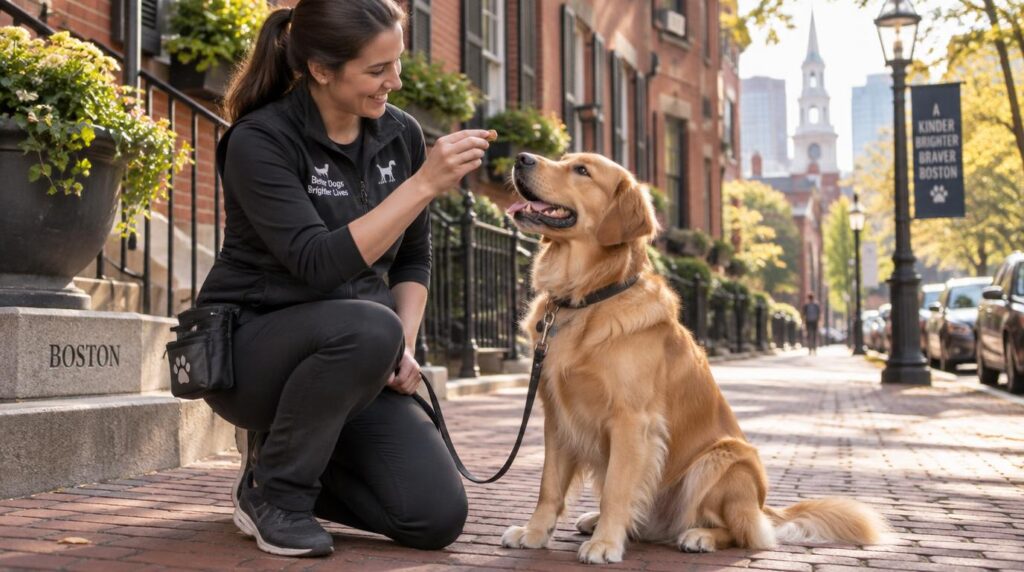
Best Dog Training in Boston, MA (2026): Top Trainers, Classes & Prices
Boston is home to some of the most skilled certified dog trainers in New England — from private behaviorists in Cambridge to group obedience classes in Brookline, South End, and Somerville. This guide covers the best dog training options in Boston for 2026, including what to expect, how much it costs, and how to find the right trainer for your dog’s needs.
This guide is for informational purposes. Always contact providers directly for current pricing, availability, and scheduling. Always verify trainer credentials before booking.
Why Dog Training Is Essential for Boston Dogs
Boston presents unique challenges for dog owners that make professional training especially valuable. With one of the densest urban environments on the East Coast, Boston dogs must navigate crowded sidewalks in neighborhoods like Back Bay, Beacon Hill, and the South End, share parks like Boston Common and the Esplanade with hundreds of other dogs and visitors, and handle the sensory intensity of subway stations, construction, and street festivals year-round.
Add to that Boston’s punishing winters — where months of limited outdoor activity can cause pent-up energy and behavioral regression — and you have a city that genuinely rewards early, consistent dog training investment.
Whether you have a new puppy from South Boston or an adolescent rescue you adopted in Jamaica Plain, the right trainer can make life in Boston dramatically easier for both of you. Browse available dog trainers in Boston at HeiBob’s Boston dog training listings.
Top Dog Trainers in Boston, MA (2026)
Boston has a strong community of certified professional dog trainers with diverse specializations — from basic puppy kindergarten to advanced reactive dog programs. Here’s what to know about the major types of training services available:
Private In-Home Trainers
Private trainers come to your home or work one-on-one at a training facility. This is the most effective option for dogs with behavioral problems, new puppies, or owners who need individualized attention. Boston’s private trainers typically charge $125–$200 per session, with most offering packages of 4–6 sessions.
Group Obedience Classes
Group classes are taught in dog-friendly spaces like pet stores, training facilities, and community centers throughout Greater Boston. They’re excellent for socialization and basic obedience at a more affordable price point — typically $50–$100 per session, or $250–$500 for a 6-week course. Look for classes in Cambridge, Somerville, Allston/Brighton, and Brookline.
Board and Train Programs
Board and train (“doggy boot camp”) programs place your dog with a trainer full-time for 2–4 weeks of intensive training. This option is available from several Boston-area trainers and typically costs $1,500–$4,000 depending on duration, behaviors addressed, and the trainer’s experience level.
Virtual Dog Training
Remote training sessions via video call have become popular with Boston’s busy professional population. Prices are typically $80–$150 per session — more affordable than in-person, and effective for many common behavioral issues like jumping, barking, and leash pulling.
Puppy Classes & Puppy Kindergarten
Early socialization is the single highest-impact investment for a Boston puppy. Look for puppy kindergarten classes that accept dogs from 8–16 weeks (often immediately after the second vaccination, per American Veterinary Society of Animal Behavior guidance). Classes typically run $200–$400 for 4–6 weeks.
Types of Dog Training Available in Boston
Boston trainers offer a wide spectrum of training approaches and specializations:
- Basic obedience: Sit, stay, down, come, leave it, loose-leash walking — the foundational skills every Boston dog needs for safe urban living
- Reactive dog training: Highly in-demand in Boston due to urban density; uses desensitization and counter-conditioning to help dogs who bark and lunge at other dogs or people
- Separation anxiety treatment: A specialized protocol (the Malena DeMartini method is gold standard) for dogs who cannot be left alone — critical for Boston’s many work-from-home residents returning to office
- Fear & anxiety rehabilitation: Structured programs for rescue dogs or dogs with a history of trauma
- Puppy socialization & biting inhibition: Foundational work during the critical 8–16 week window
- Advanced obedience & off-leash training: For dogs who have mastered the basics and are ready for greater freedom at parks like Minuteman National Historical Park
- Canine Good Citizen (CGC) preparation: AKC certification that demonstrates good manners — often required for therapy dog programs and some Boston apartment buildings
- Service dog training: Specialized task training for emotional support and service roles
Find dog trainers by specialty at HeiBob’s dog training directory.
Dog Training Prices in Boston, MA (2026)
Boston is one of the more expensive cities in the US for professional services — dog training included. Here’s what to expect:
| Training Type | Session/Package Cost | Duration | Best For |
|---|---|---|---|
| Private session (in-home) | $125–$200 per session | 60–90 min | Behavioral issues, personalized training |
| Private session package (4–6) | $500–$1,000 | 4–6 weeks | Structured behavior modification |
| Group obedience class | $50–$100 per class / $250–$500 for course | 45–60 min / 6 weeks | Basic obedience, socialization |
| Puppy kindergarten | $200–$400 for course | 4–6 weeks | Puppies 8–16 weeks |
| Board & train (2 weeks) | $1,500–$3,000 | 2 weeks | Intensive behavior modification |
| Board & train (4 weeks) | $3,000–$4,500 | 4 weeks | Complex behavioral issues |
| Virtual session | $80–$150 per session | 45–60 min | Busy schedules, management strategies |
Pricing sourced from Bark.com Boston listings and Pawnicki.com, September 2026. Prices vary by trainer credentials, specialization, and location within Greater Boston.
Money-saving tip: Many Boston training facilities offer a free or reduced-price introductory consultation. Ask about multi-dog household discounts if you have more than one pet.
Dog Training in Boston’s Key Neighborhoods
Boston’s distinct neighborhoods each have their own training dynamics and community resources:
Back Bay & Beacon Hill
These dense, historic neighborhoods are filled with apartment-dwelling dog owners who need impeccable leash manners. The Boston Common and Public Garden are prime socialization grounds, and several private trainers specialize in small-space living skills for urban dogs here.
South End
The South End has one of the highest concentrations of dog owners in Boston. Peters Park dog park is a popular gathering spot. Trainers in this area frequently specialize in reactive dog work given the narrow streets and high density of dogs per block.
Cambridge & Somerville
Cambridge’s proximity to MIT and Harvard attracts a science-minded community that tends to prefer evidence-based, positive reinforcement training. Several well-credentialed trainers have home bases in Cambridge and Somerville, with access to the Cambridge Common and Danehy Park for outdoor sessions.
Jamaica Plain & Brookline
Jamaica Plain’s beautiful Jamaica Pond and the Arnold Arboretum offer excellent off-leash training environments (in designated areas). Brookline has a strong network of training facilities and group class programs, and is known for having several CPDT-KA certified trainers operating locally.
Allston/Brighton & Mission Hill
These neighborhoods are popular with young professionals and students who often have high-energy breeds. Training classes here tend to be more affordable than Back Bay or Beacon Hill options, making them popular first-time training destinations.
How to Choose a Dog Trainer in Boston
Boston has many skilled trainers — and also some who lack proper credentials. Here’s how to vet your options:
Key Certifications
- CPDT-KA (Certified Professional Dog Trainer): Industry standard requiring 300+ training hours and a standardized exam
- CDBC (Certified Dog Behavior Consultant): IAABC credential for behavioral consultants
- CAAB / ACAAB: Advanced academic credential for complex behavioral cases
- Veterinary Behaviorist (DACVB): For serious aggression or anxiety — available through Tufts University’s veterinary program in North Grafton, MA
Questions to Ask Before Booking
- “What training methods and tools do you use?” (Positive reinforcement is the science-supported standard)
- “What is your certification and continuing education background?”
- “Do you have experience with [my dog’s specific breed or issue]?”
- “Can I observe a training session or speak with past clients?”
- “What happens if my dog isn’t making progress after X sessions?”
Red Flags
- Any trainer who uses the phrase “alpha dog” or “pack leader” — dominance theory is not supported by current behavioral science
- Trainers who won’t explain their methods or who use tools (shock collars, prong collars) without discussing risks
- Guarantees of results in a specific number of sessions
- Board-and-train programs that won’t provide daily updates or video footage
Browse certified Boston dog trainers at HeiBob’s Boston dog training directory.
Frequently Asked Questions About Dog Training in Boston, MA
How much does dog training cost in Boston, MA in 2026?
What is the best dog training method for Boston dogs?
Where can I find a certified dog trainer in Boston?
Is my Boston apartment okay for keeping an untrained dog?
Are there free or low-cost dog training resources in Boston?
How long does it take to train a dog in Boston?
📖 More Pet Care Guides
Best Dog Groomers in Durham, NC (2026)
Durham’s Research Triangle market is home to top-rated dog groomers. Compare prices and services…
Best Dog Groomers in Corpus Christi, TX (2026)
Find the best dog groomers in Corpus Christi TX for 2026. Compare prices, services and reviews…
How Much Does Dog Grooming Cost in 2026?
Average prices by breed and service. Compare costs for baths, haircuts, nail trims and full grooms…
Find a Dog Trainer in Boston, MA
Ready to start training? Browse certified dog trainers across Boston’s neighborhoods on HeiBob — compare credentials, read reviews, and find the right fit for your dog.
Browse Boston Dog Trainers on HeiBob →

Leave a Reply
You must be logged in to post a comment.