
Dog training methods vary widely — from positive reinforcement to e-collar training — and choosing the right one can make the difference between a well-behaved companion and a frustrated pet owner. This complete guide breaks down every major dog training method, how each works, its pros and cons, and which dogs and situations each suits best so you can make an informed decision.
This guide is for informational purposes. Always consult a certified professional dog trainer for advice specific to your dog’s needs and temperament.

What Is Dog Training?
Dog training is the process of teaching a dog specific behaviors, responses, and skills through various techniques and consistent practice. Whether you’re working on basic obedience commands like “sit” and “stay,” curbing destructive behaviors, or preparing a dog for agility competitions, the method you choose shapes how your dog learns — and how your relationship develops over time.
Modern dog training has moved significantly away from punishment-heavy approaches toward science-backed methods that respect canine psychology. The American Veterinary Society of Animal Behavior (AVSAB) recommends reward-based training as the primary technique for all dogs. However, several distinct schools of thought still exist, each with passionate advocates.
Understanding the different dog training methods helps you select the right approach for your dog’s age, breed, temperament, and the specific behaviors you want to address. Browse certified dog trainers on HeiBob to find a professional near you.
Positive Reinforcement Training
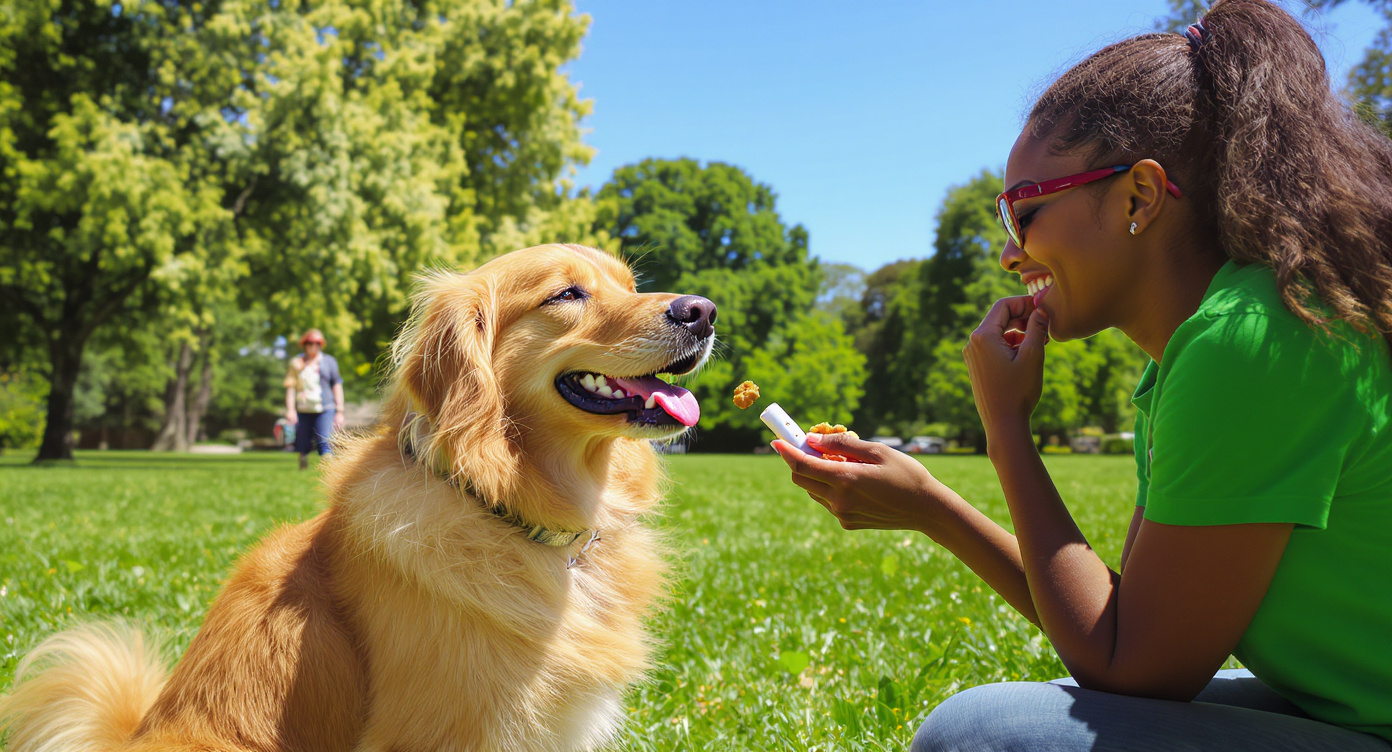
Positive reinforcement is the most widely recommended and scientifically validated dog training technique. The concept is straightforward: reward the behaviors you want to see more of, and ignore or redirect the behaviors you want to extinguish. Rewards include treats, praise, play, or toys — whatever motivates your individual dog.
The method is grounded in operant conditioning, specifically B.F. Skinner’s research showing that behaviors followed by positive outcomes are more likely to be repeated. For dogs, this means marking a desired behavior (sitting, lying down, coming when called) immediately with a reward, creating a strong positive association.
How Positive Reinforcement Works
- Lure: Use a treat to guide the dog into position (e.g., move treat over head to get a “sit”)
- Mark: The instant the dog performs the behavior, say “yes!” or click a clicker
- Reward: Immediately deliver the treat or praise within 1–2 seconds
- Repeat: Practice in short 5–10 minute sessions, gradually adding verbal cues
- Fade the lure: Once the behavior is reliable, wean off physical lures while keeping verbal cues
Pros and Cons
| Pros | Cons |
|---|---|
| ✅ Builds trust and a positive relationship | ⚠️ Requires consistency from all family members |
| ✅ Recommended by vets and animal behaviorists | ⚠️ Can be slow for emergency behaviors |
| ✅ Works for all ages and breeds | ⚠️ Dogs may become treat-dependent if rewards aren’t faded |
| ✅ Reduces anxiety and fear | ⚠️ Requires patience and timing precision |
Best for: Puppies, fearful dogs, dogs with anxiety, families with children, all breeds. This is the default recommendation from most certified trainers. Find a positive reinforcement trainer near you on HeiBob.
Clicker Training
Clicker training is a specific application of positive reinforcement that uses a small handheld device that makes a distinct “click” sound to mark the exact moment a dog performs a desired behavior. The click acts as a precise, consistent signal (called a “bridge”) that tells the dog: “That thing you just did earned you a reward.”
Developed by marine mammal trainer Karen Pryor in the 1980s, clicker training has become one of the most precise dog training techniques available. Because the click is faster and more consistent than a spoken word, it gives clearer feedback during complex behavior shaping.
How Clicker Training Works
- Charge the clicker: Click and immediately give a treat 10–20 times so the dog associates the click with reward
- Capture or lure: Wait for the dog to offer a behavior naturally, or guide it
- Click the instant: The moment the target behavior occurs, click — don’t wait
- Reward: Follow every click with a treat, no exceptions (especially while teaching)
- Add a cue: Once the behavior is consistent, add a verbal or hand signal
Clicker training excels at shaping complex behaviors in small steps (called “shaping”). For example, teaching a dog to close a door requires clicking for touching the door, then pushing it, then pushing it hard enough to close — each step rewarded until the full behavior is learned.
Best for: Dogs learning complex tricks or agility, highly food-motivated dogs, owners who want precise communication. Not ideal for dogs that are noise-sensitive to the click sound.
Relationship-Based Training
Relationship-based training, sometimes called “holistic” or “bond-based” training, prioritizes the emotional connection between dog and owner above all else. Rather than simply conditioning behaviors through rewards or corrections, this approach focuses on understanding each dog as an individual — reading its body language, respecting its emotional state, and building cooperation through mutual trust.
Before asking a dog to perform a behavior, the trainer ensures the dog’s environment is appropriate, its needs are met, and its stress levels are low. If the dog fails to perform, relationship-based trainers ask “why” before applying any correction or reward.
Key Principles
- Understand your dog’s body language, stress signals, and individual personality
- Meet the dog’s physical, mental, and social needs before training sessions
- Reward behaviors align with what motivates the specific dog (not all dogs love food)
- Build communication through observation rather than mechanical repetition
- Use the minimum force/pressure necessary — ideally none
Best for: Dogs with trauma history, rescue dogs, dogs with complex behavioral issues, owners interested in a deeper human-animal bond. Often used in combination with positive reinforcement.
Alpha/Dominance Training
Dominance-based training, popularized in the 1970s–2000s and associated with trainers like Cesar Millan, is based on the idea that dogs live in a pack hierarchy and owners must establish themselves as the “alpha” or pack leader. Techniques include physical corrections, “alpha rolls” (forcing a dog onto its back), and assertive body language.
However, the scientific foundation of dominance theory has been significantly challenged. Research has shown that wolf packs (which the theory was based on) don’t actually operate through rigid dominance hierarchies — the studies used captive, unrelated wolves, not natural family packs. The AVSAB and most certified behaviorists now advise against dominance-based techniques as they can increase fear, anxiety, and aggression in dogs.
| What Proponents Claim | What Research Shows |
|---|---|
| Dogs need a “pack leader” to feel secure | Dogs are not wolves; domestic dog behavior differs significantly |
| Physical corrections establish authority | Aversive methods increase fear and can trigger aggression |
| Quick results with stubborn dogs | Compliance through fear isn’t reliable long-term |
Bottom line: Most modern certified trainers — and veterinary behaviorists — recommend avoiding dominance-based techniques and instead using positive reinforcement methods that build genuine cooperation.
Scientific Training
Scientific training isn’t a single technique but rather an approach grounded in ongoing behavioral research. Scientific trainers commit to using only methods backed by current animal behavior science, updating their approaches as new research emerges. This typically means heavy reliance on positive reinforcement and operant conditioning, combined with a nuanced understanding of classical conditioning, desensitization, and counterconditioning.
Scientific trainers understand the “quadrants” of operant conditioning:
- Positive Reinforcement (R+): Add something pleasant to increase a behavior (give treat for sit)
- Negative Punishment (P-): Remove something pleasant to decrease a behavior (turn away if dog jumps)
- Positive Punishment (P+): Add something unpleasant to decrease a behavior (e.g., correction collar)
- Negative Reinforcement (R-): Remove something unpleasant to increase a behavior (release leash pressure when dog heels)
Most science-based trainers work primarily in R+ and P- quadrants, minimizing or eliminating P+ and R- techniques. This approach is endorsed by the American College of Veterinary Behaviorists and the International Association of Animal Behavior Consultants (IAABC).
Model-Rival Training
Model-rival training (also called observational learning) was developed by Dr. Irene Pepperberg in her famous research with Alex the African Grey parrot. The method uses a human model to demonstrate the desired behavior to the dog — the dog observes and then imitates.
In practice, two humans interact: one acts as the trainer, the other as the “model” who earns rewards by performing the target behavior correctly. The dog watches and competes for the trainer’s attention. When the dog imitates the behavior, it gets rewarded. This taps into dogs’ natural social learning abilities.
Best for: Intelligent, socially motivated breeds. Less common than other methods but effective for complex tasks. Often used in combination with reward-based training.
Comparing All Dog Training Methods (2026)
Use this table to compare the major dog training techniques side by side. Choosing the right method depends on your dog’s temperament, your training goals, and whether you’re working with a professional trainer or on your own.
| Method | Core Principle | Uses Aversives? | Best For | Vet Endorsed? |
|---|---|---|---|---|
| Positive Reinforcement | Reward desired behaviors | No | All dogs, all ages | ✅ Yes |
| Clicker Training | Precise reward marking | No | Complex behaviors, agility | ✅ Yes |
| Relationship-Based | Bond and communication first | No | Rescue dogs, anxious dogs | ✅ Yes |
| Scientific Training | Evidence-based methods | Minimal (P- only) | All situations | ✅ Yes |
| Model-Rival | Observational learning | No | Intelligent breeds | ✅ Yes |
| Dominance/Alpha | Pack hierarchy control | Yes (often) | Not recommended | ❌ No |
Source: American Veterinary Society of Animal Behavior (AVSAB), IAABC — 2024 guidelines.
Which Dog Training Method Is Right for You?
For most dog owners, positive reinforcement combined with clicker training is the gold standard. It works for puppies as young as 8 weeks, senior dogs learning new tricks, and everything in between. If you’re dealing with serious behavioral issues — aggression, severe anxiety, compulsive behaviors — consult a Certified Applied Animal Behaviorist (CAAB) or a board-certified veterinary behaviorist rather than attempting correction-based methods at home.
When comparing trainers, look for certifications from recognized bodies:
- CPDT-KA (Certified Professional Dog Trainer – Knowledge Assessed)
- CAAB (Certified Applied Animal Behaviorist)
- CDBC (Certified Dog Behavior Consultant via IAABC)
- KPA CTP (Karen Pryor Academy Certified Training Partner)
Browse certified dog trainers in your city on HeiBob — all listings include reviews, services offered, and contact details.
Frequently Asked Questions About Dog Training Methods
What is the best dog training method in 2026?
The best dog training method is positive reinforcement — rewarding desired behaviors with treats, praise, or toys. It is endorsed by the American Veterinary Society of Animal Behavior (AVSAB), is effective for all breeds and ages, and builds a strong bond between dog and owner. Combining it with clicker training gives even more precise communication.
How many dog training methods are there?
There are six main dog training methods: positive reinforcement, clicker training, relationship-based training, scientific training, model-rival training, and dominance/alpha training. Most professional trainers today use a blend of the first four, all of which are science-backed and reward-focused.
Is positive reinforcement dog training really effective?
Yes — positive reinforcement is scientifically proven to be highly effective. Multiple studies show that dogs trained with reward-based methods learn faster, retain behaviors longer, and display fewer anxiety-related behaviors than dogs trained with aversive methods. It’s the primary recommendation from veterinary behavioral organizations worldwide.
What is the difference between clicker training and regular positive reinforcement?
Clicker training is a specific form of positive reinforcement that uses a mechanical click sound as a precise “marker” to tell the dog exactly which behavior earned the reward. The click is faster and more consistent than a verbal “yes,” making it especially useful for shaping complex behaviors in small steps. Both methods use rewards — clicker training just adds more precise timing.
Is dominance-based dog training dangerous?
Dominance-based training can be harmful. Research shows that techniques like alpha rolls, scruff shakes, and physical corrections can increase fear, anxiety, and even aggression in dogs. The AVSAB and the American Animal Hospital Association (AAHA) specifically advise against these methods. Modern trainers almost universally use positive, reward-based approaches instead.
How do I find a certified dog trainer near me?
Look for trainers certified by recognized organizations such as the CPDT-KA (Certified Professional Dog Trainer), CAAB (Certified Applied Animal Behaviorist), or IAABC (International Association of Animal Behavior Consultants). You can also browse vetted dog trainers on HeiBob to find certified professionals in your area with verified reviews.
How long does it take to train a dog?
Basic obedience commands (sit, stay, come, down) can often be taught in 4–8 weeks with consistent daily practice of 5–10 minutes per session. More complex behaviors or overcoming ingrained habits may take 3–6 months. Puppy classes typically run 6–8 weeks. The key factor is consistency — the same commands, same rewards, and the same rules from all family members.
📖 More Pet Care Guides
Best Dog Boarding in Nashville, TN (2026): Top Kennels, Cage-Free Resorts & Prices
Looking for the best dog boarding in Nashville, TN? Compare top-rated kennels, cage-free resorts, an…
Best Dog Training in Phoenix, AZ (2026): Top Trainers, Classes & Prices
Looking for the best dog training in Phoenix, AZ? Compare top-rated trainers, obedience classes, boa…
Best Pet Shops in Houston, TX (2026): Top Stores for Supplies, Exotic Pets & More
Looking for the best pet shops in Houston, TX? Houston’s pet stores range from massive chain r…
Ready to find the right trainer for your dog? Browse certified dog trainers on HeiBob — filter by city, training style, and specialty. Whether you’re looking for puppy classes, obedience training, or help with behavioral issues, HeiBob connects you with trusted professionals near you.



Leave a Reply
You must be logged in to post a comment.